Tag Archives: star wars

A review of “Solo: A Star Wars Story” (2018)

Was “Solo: A Star Wars Story” (2018) really quite as bad as everyone said it was?

Yes, I do understand why it’s so maligned by “Star Wars” purists.  Han Solo has arguably been the entire franchise’s most memorable protagonist since his debut in its very first film in 1977.  (When we were kids and playing “Star Wars” in the street, how many of us wanted to be Luke Skywalker and how many of us wanted to be Han?)

Disney missed an opportunity to serve up what fans undoubtedly wanted — an edgy origin story that took risks to portray this famously wily criminal anti-hero.  What the studio gave us instead is a generally toothless, safe-for-primetime fable that even managed to become saccharine at times.  (You could argue that Luke’s origin story was far darker — he discovered the burned bodies of murdered aunt and uncle.  Then he studied magical martial arts with the mysterious mystic samurai-hermit who once fought wars with his absent father.)  “Solo” feels too much … like a Disney movie.

There are other problems too … its narrative is unfocused, it’s cluttered with too many characters, and, yes, it slavish attention to origin-story details is annoying.  (The how-Han-Solo-got-his-surname bit, for example, is indeed a big misfire.)

But “Solo” felt far more like an average film to me, instead of one that was truly terrible. I’d rate it a 6 out of 10 for being an acceptable, passably entertaining “Star Wars” entry.  It’s got a few things going for it.

It’s well cast, for one.  I was actually very surprised at how well actor Alden Ehrenreich captures the character of a young Han Solo.  They guy has natural charisma, and he seems to absolutely channel the character without once mimicking Harrison Ford.  You could do a lot worse.  Ehrenreich also has great chemistry with Chewbacca (Joonas Duotamo), and with Donald Glover, who equally shines in the role of a young Lando Clarissian.  If you put the three of them in a sequel with a leaner, darker screenplay aimed firmly at adults, it could be a truly great movie.  (Consider how lame the first “Captain America” movie was in 2011, and how its far darker 2014 sequel was so unexpectedly great.)

“Solo” also has great visual effects.  (All the newer “Star Wars” movies have come a long way from the clumsy, heavy handed CGI of the prequels.)  The Kessel Run sequences were especially good, and I’m still enough of a kid at heart to love those kind of dazzling set-pieces, even when they punctuate a lackluster script.

“Solo” was the sixth most expensive film ever made, at $392 million, and it was a complete commercial failure.  So I doubt we’ll ever see these versions of the characters again in theaters.  But what about television?  What about streaming services?  I, for one, would keep an open mind about whether Disney could do better with this film’s ingredients.


Solo-Movie

A very short review of “Guardians of the Galaxy” (2014)

I had fun with “Guardians of the Galaxy” (2014).  I’d rate it an 8 out of 10, if a little grudgingly.  For me, it started quite strong with its introduction of Chris Pratt’s roguish space antihero; I actually had no idea he could be this funny.  (I’ve only seen him once before, weighed down by the failed comedic scripting of 2015’s “Jurassic World.”)

I’m sorry to say that my interest in “Guardians of the Galaxy” waned just a bit as it subsequently unfolded as a cartoonish, relatively tame, family-friendly adventure — complete with a heartwarming value-of-friendship lesson.  That’s fine, I guess — it’s cool and it makes sense that the Marvel Cinematic Universe should offer films more appropriate for younger viewers.  Can you imagine, however, how hilarious this movie would be if it truly deserved its (befuddling) PG-13 rating, and really pressed the envelope?  Between Pratt’s wit and these offbeat character concepts, it would be amazing.

I still had fun with this, though, thanks mainly to the action and the impressive special effects.  I’d recommend it, and I’m planning on seeing the sequel.

Postscript — people are saying that this is the MCU’s answer to “Star Wars,” and I suppose it could be.  But I had a lot more fun thinking that the movie was channeling Harry Harrison’s priceless science fiction book series featuring criminal-antiheroes — the “Stainless Steel Rat” adventures.


MV5BMTAwMjU5OTgxNjZeQTJeQWpwZ15BbWU4MDUxNDYxODEx._V1_SY1000_CR0,0,674,1000_AL_

To those rebutting my “Star Wars: The Last Jedi” review:

(Specifically my complaint that the near-godlike “Force” powers employed are neither supported by the script nor precedented in the prior films.)

The Force is the Force, of course of of course,
And no one can limit the Force, of course,
Unless, of course, they use the Force
As a shameless deus ex machina!!!

[sung to the tune of “Mister Ed”]


Warriors_Star_Wars_The_Last_Jedi_Swords_535028_716x1024

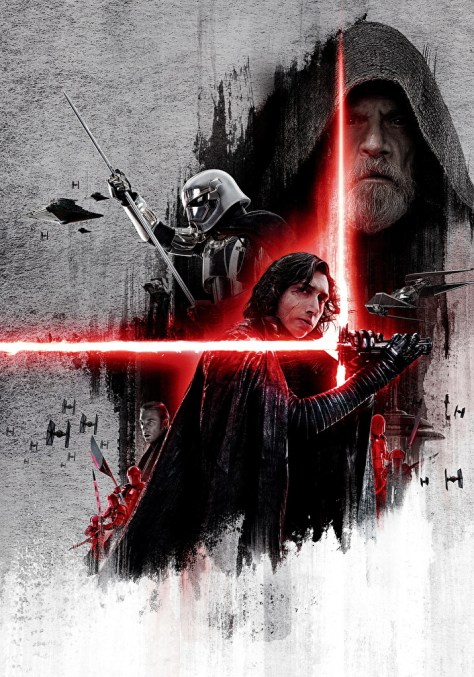
A short review of “Star Wars: The Last Jedi” (2017)

I’ll never be able to love “Star Wars” the way its lifelong fans do.  After the unexpected magic of the first three films, the subsequent movies almost always seemed to me to be just space fantasies for kids, formulaically developed to hit all the right notes and sell licensed merchandise.  (The exception would be last year’s generally excellent “Star Wars: Rogue One,” which uniquely felt like a genuine, human story that a creator wanted to tell, rather than something brainstormed until consensus in a corporate writers’ room.)  With that said, I’ll happily report here that “Star Wars: The Last Jedi” was actually very good — as someone with little favorable bias toward the franchise, I’d rate it an 8 out of 10.

The movie simply got more right than it got wrong.  It’s still a marketing-oriented space opera developed for mass appeal, but it managed to rise above that because its many elements included more hits than misses.

If I had to pick one thing that made this movie succeed for me, it’s the balance it struck between its epic war story and its narrower sword-and-sorcery central plot thread.  I like how the film began with an interstellar war — it had ordinary, mortal, relatable human characters fight and make sacrifices.  Anyone can relate to characters like that because they are interchangeable with people fighting a war in our world.  (It was also excellently rendered, in terms of fantastic visuals and some creative ideas.)  Only afterward does the movie layer in the far-out Jedi stuff, which contrasts the war story and adds complexity to it.

The second thing I liked about it was its terrific special effects — I’ve never seen a “Star Wars” movie without them, even if the prequels had a more cartoonish, toylike quality to what they depicted.

The third, I think, was the return of Mark Hamill’s Luke Skywalker.  Hamill is actually quite a good actor, and his skilled turn here was alternately funny and dramatically convincing.  I found myself more nostalgic after watching Luke’s return to the franchise than after Han Solo’s return in “Star Wars: The Force Awakens” (2015).  (And I love Harrison Ford just as much as everyone else in the universe.)

Is there a lot to nitpick?  Sure.  In addition to some plot holes, the character of Rose was rather annoying.  (Spunky young idealists can grate on the nerves if they’re too cutesy and seem to ingratiate themselves to the viewer.)

But a far larger weakness is that “the force” has become more of a deus ex machina than ever before.  I can’t be specific here because I want to avoid spoilers, but both the Jedi and their Sith counterparts employ incredible new powers in the movie that are absolutely unprecedented.  It isn’t explained at all, and it isn’t consistent with any prior “Star Wars” movie.  And it feels like a cheat that is both sweeping and … a little strange.

Still, I’d recommend this movie — even if you didn’t love every “Star Wars” movie you’ve seen in the past.

I’ll end with a quick note about the “porgs” — those little penguinesque aliens that are supposedly dividing longtime fans into opposing war-camps.  I loved the damn things.  It makes perfect sense that Luke’s hideaway planet would have local fauna.  And I read that the filmmakers actually did include them for an understandable reason.  The island shooting location’s landscape was inhabited by puffins.  It made more sense to overwrite them with CGI stand-ins than to digitally remove them altogether.


the-last-jedi-theatrical-blog

THE “BLADE RUNNER 2049” TRAILER DROPPED THIS MORNING.

OH MY GOD OH MY GOD OH MY GOD OH MY GOD

Just hearing the theme music brought tears to my eyes.  This is “Star Wars” for the moody, fucked-up, philosophical 80’s kids!!!

Oh, Deckard!!!


A short review of “Rogue One: A Star Wars Story” (2016)

“Rogue One: A Star Wars Story” is every bit as good as you’ve heard; even this non-“Star Wars” geek had great fun with it.  I’d cheerfully give it a 9 out of 10, and I’d recommend you give it a try even if you don’t typically enjoy the franchise.

Die-hard fans are currently noting all of the things that make this film unique in the series: it’s the first “Star Wars” movie without a Jedi, the first without the trademark opening text-crawl, the first one without a lightsaber duel.

Casual fans might be more impressed with more general differences.  Two stood out for me.

One, this is the first Star Wars film since “The Empire Strikes Back” (1980) that seems aimed mainly at adults.  Yes, the fairy tale elements are still there — we have an underdog orphan searching for her father, the requisite anthropomorphic aliens, and a humorous robot mascot (which surprisingly worked quite well).  But those elements are absolutely upstaged by a bona fide war film, complete with tactics, strategy, panic, collateral damage and casualties.  I remember thinking during a surprisingly gritty urban warfare scene that it was as though some filmmakers had taken a scene from a film like “The Hurt Locker” (2008) and set it within the “Star Wars” universe.

Two, I think that this is the most human Star Wars movie we’ve had since “Empire.”  It wouldn’t be “Star Wars” without the aforementioned aliens and robots, and plenty of references are made to the Force and the Jedi.  But this is a movie about ordinary people.  Yes, there is one larger-than-life character who appears … force-sensitive?  This universe’s equivalent of Marvel’s “Daredevil?”  (This was a confusing story element that didn’t always work for me.)  But we are presented primarily with all-too-human anti-heroes who feel fear, suffer, and die.

Isn’t that more exciting than watching cartoonish aliens fight armies of equally cute battle-droids?  In this film’s better moments, it made me feel like a was watching a “real” war with “real” people, and I was surprised to find myself actually rooting for the good guys in a “Star Wars” film — this has been a series that I’ve long half-dismissed as being essentially children’s stories.

Seriously, this was a good movie.  Check it out.


A review of “Damnation Alley” (1977)

I’m not sure how to review “Damnation Alley” (1977).  I can’t call it a classic.  Portions of it are just too poorly made for that — even to the point where it deserves the “Mystery Science Theater 3000” treatment.  But it is an extremely enjoyable 1970’s end-of-the-world flick, it has some notably successful key scenes and it’s nothing less than venerated by people who love 70’s science fiction.

The movie’s story sounds as though it were conceived by scientifically illiterate teenagers who were passing a joint around … and the joint was laced with hallucinogens, and it was the crazy 70’s.  A nuclear war with Russia has actually tilted the earth on its axis, so it’s spinning askew.  This (and apparently not radiation or nuclear winter) has caused all sorts of cataclysms, and mankind’s best hope is that, through an act of God or something, the correct axis just sort of … reasserts itself.  In the meantime, the same threats you’d usually expect are inhabiting 70’s cinema’s postapocalyptic America: sick hillbillies and mutant fauna.

A trio of United States Air Force servicemen are forced to leave a protected California missile silo that has allowed them to survive the holocaust.  (It burns down after a drunk commanding officer passes out and drops a lit cigarette.  Seriously.)  Our heroes embark across America in the desperate hope to reach the one city that has apparently survived the nuclear fire.  And that’s Albany, for some reason.

I’m pretty sure Roger Zelazny’s 1967 novel, upon which this is ostensibly based, has little to do with this simplistic and head-scratching screenplay.  The book sounds much smarter and more interesting.

The movie gets off to a rocky start, in an ineptly blocked scene in which the director can’t even manage to get the three principal actors to make their faces visible during their conversation with one another.  (These would be a pre-“The A-Team” George Peppard, a pre-“Airwolf” Jan Michael Vincent, and a pre-“Terminator” Paul Winfield.”)  Just after this is an action sequence with “giant” scorpions that are composited onto the action via blue-screen.  The special effects here are embarrassingly bad; for a frame of reference, consider that this is the same year that the studio, 20th Century Fox, also released “Star Wars.”

Still, this ridiculous movie rises above its failings with some elements that were damn good.  For starters, I inexplicably found myself liking Peppard’s stern, laconic, Southern-drawled leader, and Winfield’s likable sidekick.  Even Vincent’s mimbo antics weren’t too grating.  He must have been a fan-favorite heartthrob back in the 70’s; the writer and director keep him front and center — saving girls, cracking jokes and riding a dirtbike.  (His character, “Hell Tanner,” was actually the main protagonist of Zelazny’s book.)

Here is where “Damnation Alley” actually reminded me of some of the better George A. Romero films.  Despite thin and slightly offbeat characterizations, the protagonists still managed to turn out cool and likable.  I identified with them.  (Is it just because this and the “Dead” movies seem to portray real, regular people instead common tropes?)

Second, certain scenes worked beautifully.  A no-budget scene depicting the inside of a casino was perfectly atmospheric and haunting.  The abandoned-town-with-a-secret scene was perfect, horrifying and unforgettable.  (And it had some nicely conceived antagonists.)  What should have been a by-the-numbers, cliched, post-apocalyptic hillbilly gang turned out to be genuinely frightening.  (The actors in these minor roles were quite competent.)  Don’t these prosaically characterized evildoers menace us more effectively than the clownish supervillains of the “Mad Max” films?

And, crappy scorpions notwithstanding, some of the period special effects actually worked.  The centerpiece of “Damnation Alley,” for a lot of fans, is the “Landmaster” — the  quite genuine 12-wheel, seven-ton, futuristic amphibious armored personnel carrier constructed specifically for the movie.  (That’s it in the second photo below.)  Seeing the actual (badass) vehicle instead of a model for the film should appeal to the kid in a lot of filmgoers, even today.  (I’m not even a gearhead, and I had fun with it.)  The custom vehicle cost $350,000 to build in 1976, and it’s still a legend in the 70’s science fiction fan community.

Another “special effect” that strangely holds up over time is the movie’s depiction of “radioactive skies.”  It’s a gaudy visual effect that would be cheap and low-tech by today’s standards, and it absolutely screams “1970’s cheese.”  Yet, as a modern movie fan, I loved it.  It’s perfect for setting the film’s unintentional clumsy-yet-creepy mood; it sets the tone for a beloved vintage B-movie classic, and it’s just neat to look at.  Wikipedia has some interesting information on the back ground for “Damnation Alley” — the radioactive skies effect actually took up 10 months of post-production, despite a final result that paled in comparison to “Star Wars.”  It was a troubled production, and its story is interesting reading.

Seriously, I had fun with “Damnation Alley.”  If it isn’t quite a “classic,” then it’s at least a really fun movie to which I’m sure I’ll return.  I’d give it an 8 out of 10, and I’m going to label it a Triple F — it’s a Forgivably Flawed Favorite.

Image result for damnation alley

Landmaster.jpg

Throwback Thursday: Olivia Newton John’s “Xanadu” (1980)

No, I was never a fan of Olivia Newton John, nor am I old enough to recall her stardom in any great detail.  I need to mention “Xanadu” at least once here at this blog, however, as it is forever linked in my mind with the summer of 1980.

This song was played endlessly at the beach by sunbathing teenage girls.  They mostly went unnoticed by me, as this was the summer before I entered the third grade, and I hadn’t developed much interest in girls just yet.  But thinking of this song immediately returns me to the beach again as a little boy.  (My parents sent me there with my siblings a lot, something for which retrospect has taught me to feel thankful.)

I have a lot of memories of going to the beach in the early 80’s — burning sand, screaming for the ice cream man, and sidestepping endless arrays of discarded bottlecaps in the gravel parking lot.  (The local teenagers must have done a hell of a lot of drinking there; upturned bottlecaps hurt when you stepped on them.)  This was also the summer that my friend Brian’s little brother, Brad, erroneously told me that Han Solo died in “The Empire Strikes Back.”  (There were no “Episode” prefixes when the first Star Wars films came out.)

There was another hit by John that can transport me back the early 80’s.  That would be “Physical,” which was played and sang ubiquitously in 1981 by the girls in my fourth grade class.  (I still remember Linda, who lived on the next street, talking about John in awed tones: “A looooot of people think she is beautiful.”)

But I’d prefer not to think of that song, if I can help it.  While “Xanadu” is arguably still fun and catchy, “Physical” is best left forgotten.


https://www.youtube.com/watch?v=oWeJ9p42ufg


Throwback Thursday: Blondie

Believe it or not, I actually can remember Blondie’s “Heart of Glass” being played in the summer of 1979.  (That would have been the summer before I entered second grade.)  The song came out in September 1978; but I can pinpoint the year as 1979, because this is a vivid summer memory.  I heard “Heart of Glass”  being played loudly on a hot day by a house halfway down the street I grew up on, and I was playing with the first Star Wars figures I’d ever gotten.  (I’d adopted R2-D2 and C-3PO the prior Christmas; they lived among shuffled papers in the top drawer of the bright blue desk that Santa had also brought me.)

Blondie was a big deal.  “Call Me” and “The Tide is High” were two other hits that I heard a hell of a lot as a little boy in 1980.  You could guarantee those would come up at least once on the way to school on whatever radio station the bus driver played.  (The little kids sat toward the front; my best friend Shawn and I had a habit of sitting in the coveted “front seat” behind the driver, who was an adult we really liked.)

If you watch the truly Kafkaesque video for “The Tide is High,” you’ll actually see an utterly bizarre homage to Star Wars, in which Darth Vader morphs into … an upright robotic rat, apparently.  I am not making this up.  It’s in the second video I posted.

What’s befuddling is that I don’t think I have heard Blondie played since … the very early 1980’s, I guess.  Other superstars from the era occasionally get rediscovered.  In 1993 and 1994, for example, the kids at Mary Washington College were hit by a horrifying revival of the truly abhorrent ABBA, not to mention a couple of “songs” from (God help us), The Partridge Family.  (If you ask me, a meth epidemic would have been less troubling.)

Why not Blondie?  I don’t get that.


Throwback Thursday: the most 70’s-tastic screenshot ever!

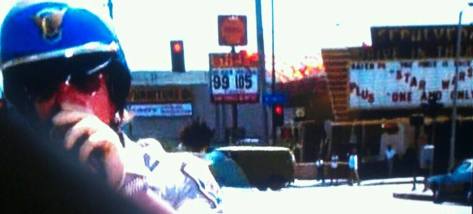
How’s this for a pop-culture artifact?   It was shared recently on Facebook by my friend Conrad.

This is a screenshot from 1977’s “CHiPs,” that weekly, family-friendly, primetime police dramedy in which a pair of affable California Highway Patrolmen would never even draw their sidearms over the course of an hour-long episode.

And, yes, the period marquee in the background is indeed advertising the original “Star Wars.”

Even at the age of five or six, CHiPs was too goofy for me — despite the fact that Shawn Degnan, my best friend next door, frequently recommended it.   Shawn and I did agree on the show’s contemporary, however — “Buck Rogers in the 25th Century” (1979-1981).


12644974_1176892385657014_4057738141963244086_n (1)