Tag Archives: 2004

A review of Season 1 of “The Haunting of Hill House” (2018)

Ghosts seldom scare me, because I’m never 100 percent clear on what sort of threat they present to the protagonists of a horror film or TV show.  They’re not like zombies, vampires, werewolves or serial killers, all of which will do predictably horrible things to their victims.

Can ghosts … kill you?  Injure you?  That usually doesn’t make sense, given their non-corporeal nature.  Can they … scare you to death?  How would that work?  Would they cause a heart attack?  Or drive you mad?  That’s fine, I suppose, but here they’ve taken a back seat to the demons of horror films since 1973’s “The Exorcist” spawned a sub-genre with far more frightening supernatural baddies.  Are ghosts supposed to inspire existential dread, by reminding the viewers of their own mortality?  For me, that backfires — their existence would strongly suggest the existence of an afterlife, which would be paradoxically reassuring.

It’s therefore a testament to the quality of Netflix’ “The Haunting of Hill House” (2018) that it’s frequently so scary, even to me.  We find out in the first episode that its ghosts indeed do more than frighten the story’s protagonists, but it’s the show’s writing, directing and acting that make it so memorable.  It’s an a superb viewing experience, and I’d rate it a 10 out of 10.

The cast roundly shines — but especially Carla Gugino and Timothy Hutton (even if his performance was a little understated).  Catherine Parker is deliciously evil in a supporting role as the house’s most outwardly vicious spirit.  The best performance, for me, however, was the young Victoria Pedretti as the traumatized Nell — she was goddam amazing, and deserves an Emmy nomination.

Mike Flanagan’s directing was perfect — his use of long angles and colors to make lavish interiors disorienting reminded me of Stanley Kubrick’s similar sensory trickery in “The Shining” (1980).  Michael Fimognari’s cinematography was beautiful.  Even the makeup effects were damned good.  (Nothing beats Greg Nicotero’s work in “The Walking Dead” universe, but the work here is sometimes horrifying.)

I’m not the only one who loved this show either.  It is broadly praised in online horror fan circles (though I’d recommend avoiding most of those for spoilers).  I haven’t read Shirley Jackson’s 1959 novel that is its source material, but a bibliophile who I trust assured me that the show is even better.

Sure, there were some things that didn’t work for me.  “The Haunting of Hill House” actually does take a while to get where it’s going; it favors in-depth, flashback-heavy character development over advancing its plot, in much the same manner as “Lost” (2004 – 2010) once did.  And some viewers might feel the same frustration here as they would for that show.

Its story and supernatural adversaries are also distinctly Gothic.  (Your mileage may vary as to what’s a comfortably familiar trope and what’s an archaic cliche.  I myself was more interested the more modern and three-dimensional interpretation of ghost characters seen in 1999’s “The Sixth Sense.”)  I’d even go so far as the say that the first ghost that we see in any detail is actually disappointing — the otherworldly figure connected with the bowler hat felt too cartoonish for me, like something we’d see on Walt Disney World’s “The Haunted Mansion” ride.  (Trust me, they get more intimidating after that.)

Give this show a chance — and stay with it if you think it’s too slow, or if you find its characters a little unlikable at first.  You’ll be glad you did.

Weird world: if the diffident, sometimes off-putting character of Steven looks familiar to you, it might be because that’s none other than Michiel Huisman, who plays the charismatic Daario on “Game of Thrones.”


HauntingHillHouse-tp0004c_Double_Gate_Cover_houseback

George A. Romero’s “Night of the Living Dead” (1968)

So I raised a few eyebrows a while back when I praised the 2004 colorized version of the late George A. Romero’s “Night of the Living Dead” (1968).  A couple of horror fans gave me flack for it — I hope people realize that I was talking about the last (and best) colorization, adapted by Legend Films.  (There were several prior color versions, and the 1986 attempt by Hal Roach Studios was broadly and justifiably condemned.)

I also hope that people realize that my preferred version will always be Romero’s black-and-white original.  And it just so happens that I found an unusually good copy of it online, over at the Timeless Classic Movie Youtube channel.  (There are actually some really clean copies of a few great classics there, including 1964’s “The Last Man on Earth”).


Cover to “Grendel: Devil’s Reign” #3, Tim Sale, 2004

Dark Horse Comics.

2787587-03

Last night I watched a colorized version of “Night of the Living Dead.”

There are actually several colorized versions of George A. Romero’s 1968 classic floating around out there — the one I watched was the quite decent 2004 revision by Legend Films.  (I believe it’s the truly crude 1986 Hal Roach colorized version that is so widely reviled by fans — and with good reason.  Those green-skinned zombies looked awful in that one clip I watched.)

I had a blast with the Legend Films outing.  I cheerfully recommend it.  The colorization isn’t perfect, and it’s a little strange seeing the start of the zombie apocalypse rendered in occasionally pastel hues.  But this was a fun way to revisit a beloved film I’ve seen so often before, but only in black and white.  You can also finally fully appreciate how beautiful Judith O’Dea was.  (And, in my opinion, she and Duane Jones were damned terrific in this movie.)

Check out the clip below.


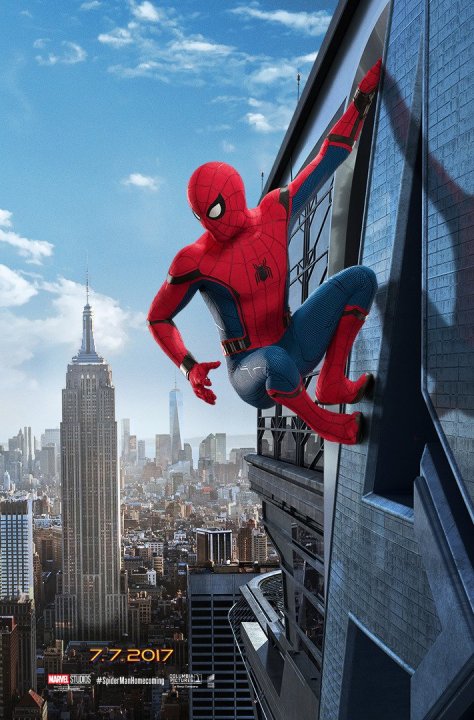
A review of “Spider-Man: Homecoming” (2017)

“Spider-Man: Homecoming” (2017) isn’t a bad movie.  To the contrary, it’s a very good one — I would even rate it a 9 out of 10, if a little reluctantly.

The action, humor, surprises and special effects are all top-notch; it’s got a slew of fun Easter eggs and great continuity within the Marvel Cinematic Universe; and Michael Keaton hits it out of the park as the story’s villain.  (As Ed Harris did recently with HBO’s “Westworld,” the sublimely likable Keaton really surprised me with how he could become so intimidating.)  Furthermore, the screenwriters wisely omit another redundant re-telling of the web-slinger’s origin.  (Even a die-hard fan like me is sick of seeing or reading about it.)

I think your enjoyment of this movie might vary according to what you want Spider-Man to be.  This isn’t a movie in which Peter Parker or his alter ego stand out as his own man (despite its plot resolution’s heavy-handed efforts to tell us that).  I submit that it’s fairly undistinguished as a standalone superhero film —  it feels like an ancillary, companion film to the “Avengers” movies, including last year’s de facto installment, “Captain America: Civil War.”  Indeed, fan-favorite Tony Stark is “Spider-Man: Homecoming’s” most significant supporting character — far more than any of the many friends, family, love interests or villains that have long inhabited the iconic hero’s mythos.  Peter’s primary motivation throughout the movie is his desire to become an Avenger, like a normal kid would aspire to the varsity football team.  Many of his powers stem from a ultra-high-tech costume designed and given to him by Iron Man; it even has an advanced A.I. that is a femme fatale equivalent of J.A.R.V.I.S.  (Fun fact: that alluring voice belongs to none other than the alluring Jennifer Connelly.  The actress is the wife of Paul Bettany, who is the voice of J.A.R.V.I.S. and then the actor portraying The Vision.  And Connelly herself played the love interest of 1991’s mostly forgotten “The Rocketeer,” a World War II-era hero with the a similar character concept to Iron Man.)

I was a big fan of Spider-Man in the 1990’s, and, believe me, the ol’ web-head did just fine with his own powers, intelligence and character — and without any sort of “internship” with Iron Man, either metaphorically or otherwise.  He was also a far more popular character with readers.  I was buying comics regularly between 1991 and 1996 — while Spider-Man books and merchandise were everywhere, I don’t think I ever remember seeing an “Iron Man” comic on the racks at my local comic shop.  I kept thinking inwardly of Spider-Man during this movie as “Iron Man Jr.,” and, for me, that wasn’t a good thing.

I also found myself musing during the film that this felt like “Spider-Man Lite.”  While “Spider-Man: Homecoming” was fun, it doesn’t have the depth, character development or gravitas of the Sam Raimi trilogy.  (Yes, I even liked the third one, despite its bizarre flaws.)  I know that critics are praising the movie’s lighter tone, and I realize the need to avoid a simple rehash of the Raimi films.  (Nobody would want that; we can rightfully expect more from the excellent MCU.)  I actually prefer the Raimi films, though.  While Tom Holland might be the better Peter Parker (Tobey Maguire was a strange casting choice), the Raimi movies were more … heartfelt.  They were an earnest exploration of the Spider-Man of the comics, and they felt … truer.   “Homecoming,” in contrast, is yet another cool installment in the “Avengers” series.  “Spider Man 2” came out 13 years ago, and I can still remember how that movie made me feel — not to mention how its sheer quality vindicated “comic book movies” like no other film before it.  This new movie will not be memorable that way.

Anyway, although my criticisms above are obviously lengthy, please know that this is only because I love the source material so much — and we comic book fans have a tendency to analyze.  I certainly enjoyed the movie, and I’d cheerfully recommend it.  (Note my rating.)  The MCU continues to entertain with quality movies; its consistency, even with its expanding group of ongoing Netflix series, is kind of astonishing.

Go see this.  You’ll have fun.


Spider-Man2

A very short review of “The Dead” (2010)

Take a look at the movie poster below for the Ford Brothers’ “The Dead” (2010).  It’s problematic for two reasons.

One, of course, is that it contains what is arguably the most unimaginative title in zombie movie history.

Two is its immediate recollection of the marketing art for Zack Snyder’s terrific 2004 “Dawn of the Dead” remake.  It is so similar in composition and color scheme that it makes the Ford Brothers’ film look like a “mockbuster,” whose cover is designed to fool hasty movie renters.

And that’s a shame, because “The Dead” is a fairly decent zombie movie in its own right — I’d rate it a 7 out of 10.  It’s a lower-budget feature, and some of the acting is a bit flat, but this is a movie that does a lot with a little.  The film wisely makes the most of its African setting, and has an intelligent, if slowly paced, story.  It focuses on its two military protagonists’ needs for food, sleep, shelter, fuel and vigilance, during the course of a lengthy overland trek.  That’s refreshing in an era of “Strippers vs. Zombies” (2012), and various fairly lackluster clones of “Shaun of the Dead” (2004).

Best of all, however, is the film’s skilled manner of evoking “slow burn” or “creeping” horror.  The zombies in “The Dead” usually move quite slowly.  They might be the slowest zombies I’ve ever seen.  This might be the anti-“28 Days Later” (2002).  But that makes the vibe here unique among the spate of modern zombie films — and maybe a little reminiscent of George A Romero’s pioneering early films.  If your reaction is like mine, you’ll find it a little unnerving to see them gather en masse at a snail’s pace.

I recommend this.

the-dead-1464333825197

A very short review of “Don’t Hang Up” (2017)

“Don’t Hang Up” (2017) is an absolutely derivative horror movie that nevertheless manages to be halfway decent.  I’d rate it a 7 out of 10.

We follow a handful of older teenage boys whose favorite avocation is perpetrating cruel prank phone calls and then posting them on the Internet.  The horror genre’s penchant for vengeance should make their comeuppance predictable.  “Don’t Hang Up” seems to borrow in equal (large) measure from the “Saw” and “Scream” film franchises, with touches of “Unfriended” (2014) and even “Silence of the Lambs” (1991).

Still, this was a halfway serviceable scary movie.  There were nice moments of tension, and it held my interest.

This doesn’t belong on anyone’s must-see list, but it’s a fun enough time-waster if you can’t find a better movie.


7gvcm8of

A tiny review of “Southbound” (2015)

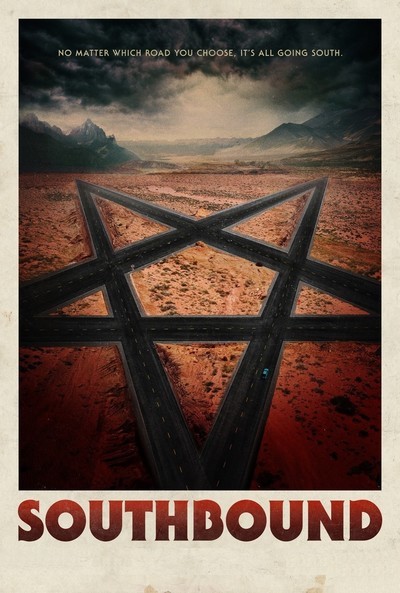
I can’t quite muster the same enthusiasm as everyone else for “Southbound” (2015) — I’d give it a 7 out of 10.  Yes, it’s clever how the five interlocking tales of this horror anthology are finally shown to weave together at the end (and it nicely parallels the equally clever movie poster below).

But the tales themselves were sometimes a little difficult to follow, with too little exposition.  One seemed incoherent.  And … exactly what was the role of the woman we see using the pay telephone?

It does have a few things going for it.  The tone is right — it’s a definitely a serious horror anthology for adults, with no camp and no gratuitous gags.

This movie was largely saved for me by the flying baddies to which we are introduced in the first entry.  (I don’t think that’s much of a spoiler, since we see them assailing us in the film’s trailer.)  They’re entirely originally, artfully grotesque, and possibly nightmare inducing.  You know what would have been an amazing movie?  A well-scripted horror-mystery in the same vein as “The Ring” (2002) or “The Grudge” (2004), focusing entirely on these antagonists.   Or maybe a supernatural desert-chase survival-horror movie.  I’d watch that.


large_ly6llsbUvXnKVnjmLrUwsbtkY5b

Thank a Veteran.

Speaking of veterans today, I’d like to mention that our own little online circle is honored to have one among us.  Blog Correspondent Pete Harrison is not only our expert on all things horror-related, but also someone who has served his country with distinction.

Pictured below before an HH-60G PAVEHAWK are members of the United States Air Force 55th Expeditionary Rescue Squadron, in the summer of 2004, in Kandahar, Afghanistan.  Pete is first left in the top row, with his arms folded.

If you enjoy the movies, books and comics that we chat about here at the blog or on Facebook, then thank a guy like Pete or one of his colleagues.  Constitutional freedoms of Speech and Press would be absent without those to defend them — not to mention our lives and our safety.

Thanks, Petey!

12235037_10153069726570388_6768569509890029867_n

A quick review of “The Visit” (2015)

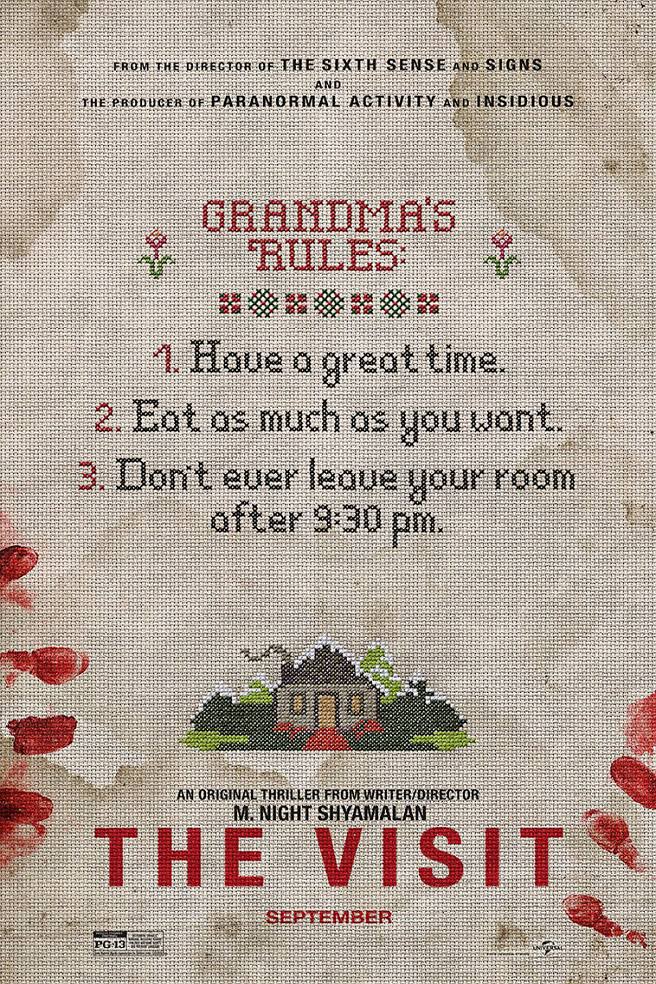
I quite liked M. Night Shyamalan’s “The Visit” (2015); I’d give it an 8 out of 10.  It is by no means a perfect movie.  But it has all of the elements of Shyamalan’s work that I love: it’s beautifully shot; it has a fresh, creative story; it’s suspenseful; it’s atmospheric, and it has well drawn, likeable protagonists.

I am an unashamed Shyamalan fan.  I love all his horror-thriller movies, even the one or two in which I can guess Shyamalan’s trademark “twist” in advance.  Yes, I even liked “The Village” (2004).  And I liked “The Happening” (2006) a hell of lot too.

This movie indeed has said twist.  I thought I guessed what it was in the opening minutes.  I was wrong, and when the real twist was revealed, it was pretty damn effective.  For a moment, I was as dumbfounded as the characters on screen.  This was despite the fact that all the clues had been right there in front of me, and seem obvious in retrospect.

And it is scary in places.  A scene beneath the house comes first to mind.  So does the “oven” bit that we see in the trailer.  The cast is uniformly good.  The standout was a fantastic performance by Deanna Dunagan as “Nana.”

A couple of things nudged this movie just slightly left of the “great” category, into the “good but not great” category.  For one, I think this could have been a short film, and didn’t need more than 40 minutes or an hour to tell its story.  The pacing seems to suffer a little because of that.  For the first hour, we keep revisiting the same arc in tension: a grandparent behaves strangely, a grandchild queries them, and then the behavior subsides.

Character choices are also implausible.  These are bright, savvy kids, who are either oblivious to or cavalier about obvious signs of danger.  I think any person in real life would be too frightened to remain in the house where “The Visit” takes place.  Later, certain things change a little too conveniently after the twist is revealed.

The rapid change in tone after the story’s conclusion was a little heavy-handed.  I thought the story’s final minutes were nice, but maybe a little too much.  (I am being intentionally vague here to avoid spoilers.)

Still, I’d recommend this.  If you can overlook the movie’s faults here and there, you’ll enjoy a damn creepy modern fairytale.

images