Tag Archives: 2015

Do not see “Tank 432” (2015)

[WARNING: THIS POST CONTAINS A MINOR SPOILER FOR THE FILM.]  “Tank 432” (2015) is alternately boring and confusing.  To be fair, its surreal story aspects are necessary to the plot, but I don’t think that redeems the movie much.

Don’t let the poster’s image of the tank and the soldier fool you — there’s a little bit of action as the film opens, but most of the movie takes place inside the titular abandoned tank, which remains stationary throughout most of the story.  (The protagonists are trapped inside it by a jammed door. )  Thereafter, the unease and claustrophobia they feel are soon felt by the audience.  Maybe that suggests skilled film-making on a certain level, but it certainly doesn’t make for an entertaining viewing experience.

The film is quite slow.  Furthermore, writer-director Nick Gillespie appears to assemble the components of several mysteries as subplots, and then leaves those smaller mysteries with little in the way of an explanation.

I’d rate this movie a 1 out of 10, and that’s only because Rupert Evans is a very good actor.


tank-432

A short review of “Split” (2016)

For much of its running length, I was considering writing a review for “Split” (2016) that rated it a perfect 10.  (I am an unabashed fan of M. Night Shyamalan, no matter how reviled he is by other Internet commentators.)  I love the way he frames his shots, I love his dialogue, I love his stories, and I love the strange way he can make a slowly paced film nevertheless absorbing.)

And “Split” looked nearly perfect.  James McAvoy handed in a tour-de-force performance as Kevin, a man with dissociative identity disorder (DID).  (Yes, I am aware of the clinical controversies connected with whether the disorder even exists — I was a psychology student many, many years ago.  I think we should suspend whatever disbelief we have for the purposes of enjoying the movie.)  McAvoy plays his role to perfection.  His “Dennis” persona is particularly frightening, and “Barry,” one of the “good personalities” he portrays, is surprisingly endearing and sympathetic.

Playing off McAvoy wonderfully are Betty Buckley as his gentle psychiatrist and Anya Taylor-Joy as one of three teenaged girls kidnapped by his nastier personalities.  The talented Taylor-Joy was also perfect in her role.  (I last saw her 2015’s “The Witch” and she was also in last year’s “Morgan;” I’m gaining the impression that this promising young specializes in cerebral horror-thrillers.)

I would rate “Split” an 8 out of 10.  It suffers a bit, I think, from two missteps toward the end.  One, this taut psychological thriller takes an ill-advised turn into dark fantasy.  I thought it was amazingly good as a thriller grounded only in the real world — it was far less so with the later jarring story elements.  (I do realize why Shyamalan made this creative decision, and you will too, after watching it and then reading up on it.)  But I still think that this would have been a perfect film if the majority of it focused on McAvoy’s personalities either aiding or misleading his psychiatrist, with Taylor-Joy’s fate hanging in the balance.

Two, this film seemed to suffer from the too-many-endings syndrome that people often associate with Peter Jackson’s “The Lord of the Rings” movies.  We seem to have one denouement that works quite well, then a second that should have been re-shot and re-scripted.  And then there’s another plot strand finally addressed … but it is played so subtly that I’m not even sure I got it.  And this isn’t even counting the significance of the movie’s final line, which works as a fantastic framing device.

About that line … if you’re a Shyamalan fan, then you simply must watch the film until it’s very end, as the camera pans through the coffee shop.  You’ll love it.


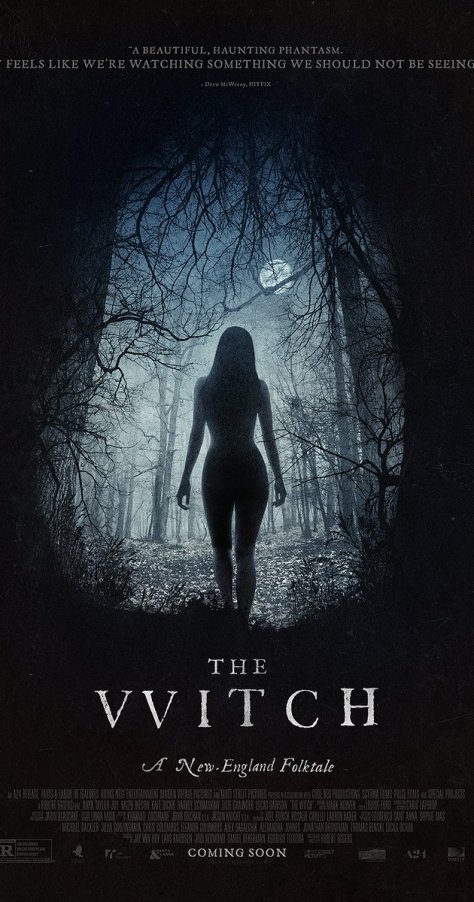
A quick pan of “The Witch” (2015)

I’ve read that renowned horror author Brian Keene criticized the popular audience backlash against 2015’s “The Witch,” saying that “90 percent of the people in the theater … will be too stupid to understand” it.  Well, maybe I am among the stupid 90 percent.  I’d name this movie as the most disappointing horror film in recent memory, and I’d rate it a 2 out of 10.

I … think I understand it.  I just didn’t like it much.  It is alternately boring and sad.  It is boring far more often than it is sad.  When it is sad, it isn’t the cathartic, meaningful, artistic “sad.”  It’s just kind of a grimace-inducing downer.  There are problems with pacing, tension and story structure.  The movie only gets interesting during its closing several minutes.

These problems, however, are overshadowed by the movie’s biggest flaw — most of the (literal) Puritans populating this period story are so unlikable that you’d care little about what happens to them.  They are verbosely, tiresomely God-obsessed.  I myself might strike a deal with the devil if he’d silence the two creepy tots, and maybe the shrewish, hysterically shrill mother (Kate Dickie), too.  He wouldn’t have to kill them or anything — muting them would suffice.

Yes, the film does succeed somewhat in establishing mood and tone.  But the result is still nothing to write home about.  This isn’t “It Follows” (2014).

The film has two things going for it.  One, as other reviewers have noted, it achieves authenticity quite well.  The sets, costumes and dialogue were so meticulously developed that I actually did believe we were in 17th Century New England.  Two, Anya-Taylor Joy wonderfully performs the role of young Tomasina.

Those two things do not redeem the film, however.  I’d skip this.


MV5BMTY4MTU2NjMyNV5BMl5BanBnXkFtZTgwMzUwMDk4NzE@._V1_UY1200_CR90,0,630,1200_AL_

A review of “X-Men: Apocalypse” (2016)

At the start of “X-Men: Apocalypse” (2016) I was worried that I was finally beginning to experience a degree of “viewer fatigue” in connection with the beloved franchise.  This would be the ninth film since the X-Men first hit the big screen in 2000, if you count this year’s “Deadpool,” and its somewhat formulaic setup felt by-the-numbers.  Once again, a diverse, earnest, international group of young people unite under Charles Xavier’s leadership to combat an even greater threat than the one presented by the last film.  (This time it’s “Apocalypse,” a Big Bad with truly godlike powers.)  And they save the day despite their youth, their inexperience, their self-doubt or the suspicions of a prejudiced humanity.)  How exciting can the arrival of Angel (Ben Hardy) and Nightcrawler (Kodi Smit-McPhee) be if these were already key reveals in past movies?  And … the cameo?

There are script problems.  The whole thing is cluttered with too many major characters.  Many are thinly drawn; a few make inexplicable, major decisions that affect the plot.  Fan favorites like Mystique (Jennifer Lawrence) and Magneto (Michael Fassbender) get too little attention to make their ardent fanbases happy, I think.  The villain looks like a middle-aged and particularly grumpy member of Blue Man Group.

And, yet … I still frikkin’ loved this.  I’d grudgingly give it a 9 out of 10, simply because I enjoyed it so much.  It’s the X-Men.  It’s a big-budget, globally staged smackdown with great special effects, and it was obviously made by people who love the source material and tried to stay true to it, despite its inevitably campy nature and its implausibility.  Characters like Havoc (Lucas Till) and Psylocke (Olivia Munn) are fun to watch.  (Am I the only one who nostalgically remembers the latter character from the 90’s comic books?)  There is even a really nice stab at self-referential humor poking fun at the earlier films.

This movie had two things going for it that really made me want to see it a second time around.  The first is Quicksilver.  The X-Men movies will probably never equal the skillfully made blockbusters of that other Marvel universe, but I’ll be damned if the franchise doesn’t totally beat them out in rendering this character.  (Yes, this is indeed the same character in the comics who inspired Scarlet Witch’s brother in “Avengers: Age of Ultron” (2015).)  Evan Peters brings great charisma to the role; the special effects connected with his action sequences are beautiful and goddam perfect.  He’s easily cooler and more likable than any other teen superhero I can remember — and that includes Tom Holland’s excellent new Spider-Man.

The second thing that make me want to watch it again is the action sequences.  The finale is damn fun.  I think it must be difficult to write, stage, direct and physically perform a melee among a group of combatants with various superhuman abilities and varying degrees of power.  But the climax here works.  It’s an entertaining battle that feels like it was lifted perfectly from the comics, and it ought to please fans of the genre.

Anyway, I obviously do recommend this.  Check it out.


cf7kkqeuuaeqame

A few quick words on The CW’s “Containment” (2016)

The poster for The CW’s new “Containment” seems like a ripoff for some exceptional poster art for 2007’s outstanding horror movie, “28 Weeks Later.”  That is just one of a few offhand references that the TV pilot seems to make to the film.  At one point, a panicked character blurts out the phrase “zombie apocalypse,” even though that has nothing to do with the plot.

Whatever.  Judging from the pilot, the new sci-fi thriller seems like a more or less average outing.  It isn’t bad, exactly, but it’s got plenty of room to grow.  Right now it seems like a undistinguished, mainstream television treatment of “Contagion” (2011).  I’d give it a 6 out of 10.

And, hey … just to add to the confusion, last year there was a really good British independent sci-fi-thriller, also entitled “Containment,” that also portrays a fatal disease outbreak.  I reviewed it here at the blog.  It almost seems like The CW is adopting the “mockbuster” strategy of capitalizing on viewers’ confusion of their show with superior properties.

Oh, well.


“The Revenant” (2015) was astonishingly good.

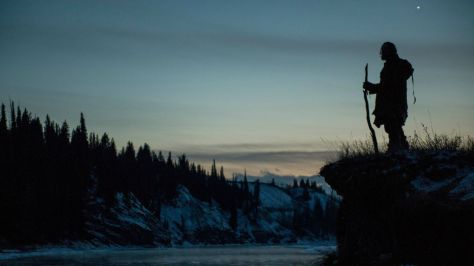
“The Revenant” (2015) changed the way that I see movies.  This utterly immersive, jaw-droppingly gorgeous period thriller is easily one of the best films I’ve ever seen, and I plan to see it again, soon.  I’d rate it a perfect 10.

It’s a visual masterpiece.  Its cinematography renders its mountains, valleys and plains both dreamlike and lucid, and its action is unflinchingly visceral.  Shot mostly in Alberta, Canada (standing in for 1823 Montana and South Dakota), the film’s visuals are more stunning than anything I’ve ever seen.  You truly do feel that “you are there.”  But “there” is an absolutely brutal 19th century middle American winter wilderness.  It’s fatally dangerous, both with its unforgiving elements and with the human violence that seems to erupt casually and constantly over its land and resources — not to mention bloody retribution among groups and individuals.  This isn’t a movie for the faint of heart.  I won’t spoil the subject of its gut-wrenching action sequences for fear of spoilers — most of these sequences arrive as frightening surprises, thanks to Alejandro G. Inarritu’s expert direction.  It is this juxtaposition of beauty and brutality that define the movie.

Leonardo DiCaprio plays Hugh Glass, an American trapper who begins as one of the seemingly few characters that do not quickly resort to unnecessary violence, prejudice or revenge.  He later does seek vengeance for his son’s death against fellow trapper John Fitzgerald, played by Tom Hardy.  (Glass was a real frontiersman who was the subject of Michael Punke’s 2002 biography, “The Revenant.”  But a cursory Google search suggests to me that this is not actually “a true story;” I think of it as loosely based historical fiction.)  Like DiCaprio and Hardy, Domhnall Gleeson and Will Poulter also excel in their supporting roles.  (Gleeson seems to specialize in playing reluctant innocents; I remember him from his skilled performance as the gentle young computer genius in last year’s outstanding science fiction thriller, “Ex Machina.”)

But the main star of “The Revenant” is the setting itself, beautifully shot by Emmanuel Lebezki and masterfully employed by Inarritu as a kind of character unto itself in the story.  It’s lovely.  I’ve never seen a movie like this.  And while I’m no film connoisseur, or even a genuine critic, I’ve seen a lot of good ones.

The direction most reminds me of Francis Ford Coppola’s work in 1979’s “Apocalypse Now.”  I was also reminded of Stanley Kubrick’s “The Shining” (1980) — that was a film that also depicted threatening snowscapes as dreamlike and eerily beautiful.  There was one shot near the end, following DiCaprio’s vengeful hero on his path through immense firs on either side — it reminded me a lot of Jack Nicholson’s murderous Jack Torrance on his path through the hellish hedge labyrinth.

There is also a central action set piece involving an attack on one group of characters on another — it actually reminded me of Oliver Stone’s work in “Platoon” (1986).  Like Stone’s finale, the battle is staged so that the viewers have no sense of which direction the attack is coming from, paralleling the experience of the confused defenders.  There are countless long tracking shots throughout this film, with fewer cuts — and amazing circular surrounding shots of the action.  I’ve read that Inarritu actually had to transport cranes to his mountaintop shooting locations in order to execute those.

If you had to find a flaw with “The Revenant,” I suppose you could complain that its story and characters are thin.  We know little more about DiCaprio’s Glass beyond that he is competent, patient and slow to fight — then merciless and unrelenting in seeking justice.  Poulter’s Jim Bridger  is loyal, but not as strong as the hero.  Hardy’s Fitzgerald is a greedy, opportunistic bully whose murder of an innocent drives the plot.  That’s … little more than the plot and characters of a lot of throwaway westerns, isn’t it?  (I’ve indeed seen this movie categorized as a western in reviews.  That’s technically correct, I guess, but it feels too unique to pigeonhole that way.)

You could easily read the movie for moral ambiguity.  There are the obvious issues connected with revenge, of course, underscored by a final shot in which one character appears to break the fourth wall.  I found myself wondering about Glass’ compatriots.  Yes, it is Fitzgerald who acts villainously, but all of Glass’ fellow trappers also consign him to death by abandoning him after his injuries.  I do understand that they feel they can’t survive themselves if they try to carry him back to their staging area at Fort Kiowa.  But … is what they do “right?”  What would you or I do?

I think I am coming too close here to revealing too much about the film.  The best way to experience “The Revenant” is to walk into it knowing little about it.  I strongly recommend you do so.


revenant-poster

The-Revenant-03

the-revenant-trailer-screencaps-dicaprio-hardy6

revenant-horse-xlarge

revenant

24115986425_3e247de327_b

“Emilie” (2015) is a superb, gut-wrenching thriller.

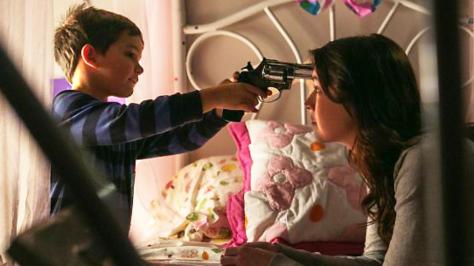
I’ll come straight to the point — “Emilie” is an exceptional horror-thriller that belongs on your list of films to see, provided you can stomach some disturbing content.  This movie hooked me in under a minute, even before its title appeared on screen.  Then it kept me glued to it throughout most of its running length.  It could have been an even better film — a classic on par with “Psycho” (1960) or “Fatal Attraction”(1987), were it not for some key creative choices about halfway through.

I’d give this movie a 9 out of 10.  It succeeds for two reasons — great acting and a script that perfectly employs dialogue that is at first subtle and nuanced, and then increasingly frightening.  The title character is a babysitter who is not what the parents expected, in more ways than one.  After some deliberately awkward character interaction with the departing parents, she proceeds to subject the children to a series of progressively more demented psychological games.  What follows is a thriller brimming with pathos.  The movie reminded me a lot of the critically acclaimed and controversial “Funny Games” (2007). That film also showed ostensibly innocent adversaries entering a family’s home after gaining their trust, and then doing awful things.

Emilie is played to perfection by Sarah Bolger, who has a beautiful, kind face, which only makes the character’s incongruous psychopathy even more unsettling for the viewer.  It took me a while to place the actress’ face, until I recognized her as the somewhat feckless protagonist of 2011’s “The Moth Diaries.”  I was impressed with her talent then as a hapless good guy, and I think her performance here was phenomenal.  She plays the innocent-looking, yet icy antagonist here with subtle, unnerving malice.  The rest of the cast is also uniformly quite good.  This is true even of the young child actors, but most especially of Joshua Rush.

The movie is briskly paced, but its sparing dialogue still manages to rattle and then shock.  It’s a sometimes obscene story of imperiled children that really gets under your skin.  Most of its directing is clean and clear.  Combined with the unusual score, it gives the story a dreamlike quality.

The movie loses its way just a little at about the 40-minute mark, when its perverse, moody dialogue and strictly psychological horror give way to the familiar elements of a boilerplate thriller.  An unnecessary backstory is given for our antagonist, delivered by an overly convenient, standard flashback sequence that feels out of place and that disrupts the pacing.  (“Her mind was shattered.”)  Then, other plot points also feel just a little by-the-numbers, moving “Emilie” away from true cinematic greatness and toward just being a very good horror flick.

Finally, Bolger’s villain is defanged a little when the script calls for her to lose her calm demeanor after the plucky, oldest child (Rush) defies her, in a well executed but entirely predictable David and Goliath story.  And her character’s reliance on a nameless, voiceless and superfluous confederate here also makes her a little less enigmatic.

How much greater would this movie have been if Emilie’s motivations remained a mystery?  What if, like “Funny Games” or “The Strangers” (2008), all we knew is that she was an highly intelligent sociopath acting for no discernible reason?  What if she were acting entirely alone?

And what if the horror remained strictly psychological, with no actual violence to up the ante until the closing minutes?  The most disturbing scenario I can think of is this — what if she were able to psychologically manipulate the children to violently turn against one another, or against their parents upon their return?  That could be an ambiguous, darker and far more thematic story than the second half of the film we see here.

Still, this was a damned effective scary movie, and that’s good enough.  I recommend it.

One more thing — there actually is a famous, heartwarming French romantic comedy entitled “Amelie” (2001), which I have not seen.  I think it would be blackly funny if some sentimental filmgoers wanted to rent that and accidentally picked up “Emilie.”


wjjgzh7t


1280x720-cOf


A tiny review of “Southbound” (2015)

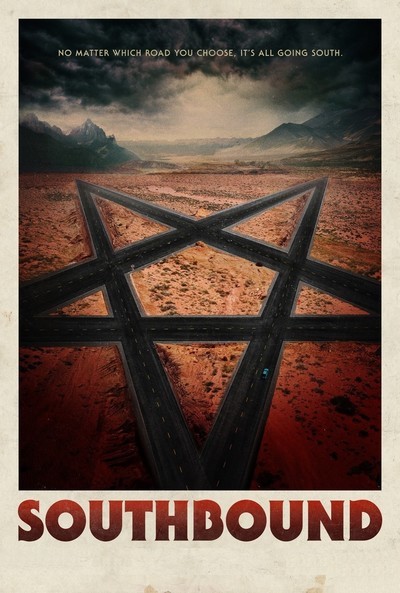
I can’t quite muster the same enthusiasm as everyone else for “Southbound” (2015) — I’d give it a 7 out of 10.  Yes, it’s clever how the five interlocking tales of this horror anthology are finally shown to weave together at the end (and it nicely parallels the equally clever movie poster below).

But the tales themselves were sometimes a little difficult to follow, with too little exposition.  One seemed incoherent.  And … exactly what was the role of the woman we see using the pay telephone?

It does have a few things going for it.  The tone is right — it’s a definitely a serious horror anthology for adults, with no camp and no gratuitous gags.

This movie was largely saved for me by the flying baddies to which we are introduced in the first entry.  (I don’t think that’s much of a spoiler, since we see them assailing us in the film’s trailer.)  They’re entirely originally, artfully grotesque, and possibly nightmare inducing.  You know what would have been an amazing movie?  A well-scripted horror-mystery in the same vein as “The Ring” (2002) or “The Grudge” (2004), focusing entirely on these antagonists.   Or maybe a supernatural desert-chase survival-horror movie.  I’d watch that.


large_ly6llsbUvXnKVnjmLrUwsbtkY5b

Wishing you the best of things to come.

Friends near and far, I wish you a Happy New Year!  I hope that 2016 brings you peace, safety, love and wonder.

The picture below is “New Year’s Eve Foxfires at the Changing Tree, Oji,” by Utagawa Hiroshige.  It’s part of his “One Hundred Famous Views of Edo,” a series of prints completed between 1856 and 1859.  I’m unfamiliar with the mythology connected with it, but it depicts foxes breathing fire at Shōzoku Inari Shrine (site of the Changing Tree) in Ōji, Tokyo.

It’s quite beautiful, and tonight it just felt right.  This is a contemplative New Year’s Eve for me, as I’ve been haunting my childhood neighborhood after visiting family in New York.  And I described for my mother at length how beautiful was the fox I found playing along the stream I so often pass down in Virginia.


Hiroshige,_New_Year's_Eve_foxfires_at_the_changing_tree,_Oji,_1857


A quick review of “Containment” (2015)

“Containment” (2015) is the film that sounds cliche but isn’t.  It’s a surprisingly fresh take on an old standby — diverse people isolated by an outside threat are forced to cope and survive with each other, along with the threat.  In this case, an entire apartment block in Britain is forcibly and mysteriously quarantined overnight; residents awaken to sealed doors and hazardous materials units being deployed along the grounds.

But this is a smartly written independent sci-fi thriller that avoids a lot of common tropes.  Then it introduces plot developments that are unexpected, yet make perfect sense.  It’s more original than you’d guess at first.

There’s a lot of nice acting, including work by Lee Ross, and by Louise Brealey of “Sherlock” (2010) fame.  And all those moody establishing shots of the tomb-quiet building were creepily effective.

My only complaint was a thematically ambiguous ending that seemed lost on me.  But I’d still give this an 8 out of 10.


91vJl5zT1XL._SL1500_