Tag Archives: 2018

A short review of “Patient Zero” (2018)

I’d be lying to you if I told you that “Patient Zero” (2018) is an especially good movie.  It isn’t.  It plays a lot like the classic “28 Days Later” (2002) would play if it were produced by the SyFy Channel, and by that I mean it generally is a poorly written, low-budget cheese-fest.  (This is one of those movies where even the score was kinda bad.)  Still, there were some hints of greatness hidden within this lackluster zombie movie — enough to save it from being a complete failure — and I would reluctantly rate it a 5 out of 10.  (Most other reviewers are not even that kind.)

First, it has some fine performers. These include two “Game of Thrones” actors who are always fun to watch — the mesmerizing Natalie Dormer and the consistently likable John Bradley.  (The latter seems to specialize in winning audiences over as the “hero’s-affable-friend” role.)  “Doctor Who” fans will of course recognize Matt Smith in the lead role.  But by far and away, they’re overshadowed by a fantastic performance by Stanley Tucci as the zombies’ surprisingly eloquent leader.  (More on that in a moment.)  Tucci is truly a great actor and he makes a perfectly menacing bad guy; his voice, diction and line delivery are goddam perfect.  His talent for voicing a magnetic, highly intelligent antagonist reminds me of Jeffrey Dean Morgan’s portrayal of Negan on “The Walking Dead,” or one of the better “big bads” seen on “24” (2001 – 2014).

Second, there are some really clever ideas hiding under this thin, hasty script.  (I strongly get the sense that “Patient Zero” was a rush job for screenwriter Mike Le and director Vincent Newman.)  The hyper-kinetic zombies here are afflicted with “super-rabies” and are reminiscent of their ilk from “28 Days Later.”  But there is a truly intriguing plot conceit — their roars and screams are perfectly intelligible to Smith’s protagonist.  He speaks their “language” because he’s infected, but also mysteriously asymptomatic.  When he interrogates the zombies for the military, their interaction is filmed as normal dialogue (creating the opportunity for Tucci’s terrific turn here).  Then things get even more interesting when it’s demonstrated that the ostensibly mindless zombies are quite proficient at planning an attack.

I … might be treating this movie a bit charitably simply because I liked some of its ingredients.  Again, I don’t actually recommend it.  But your mileage may vary.


17YBhcjXvv5BFz433OcF1UqcGzd

A short review of “Bird Box” (2018)

Netflix’ “Bird Box” generally pleases — I’d rate it an 8 out of 10, and I’d recommend it to anyone looking for a creative and effective apocalyptic horror film.  A few reviewers call it a “high-concept” horror movie because of its MacGuffin — an invasion of otherworldly beings causes anyone who looks at them to hallucinate and become suicidally depressed.  (A handful of survivors escape the chaotic mass suicides because they are lucky enough not to lay eyes on the mysterious, mind-bending creatures which can become images of their victims’ worst fears.)

It’s a hell of a setup — it reminds many people of this year’s “A Quiet Place” and 2008’s unfairly maligned “The Happening.”  (Hey, I really liked that movie.)  For some reason, “Bird Box” reminded me of the 1985 “The Twilight Zone” episode, “Need to Know.”  (It’s a great ep.)  And the plot device pays off — “Bird Box” is genuinely unsettling, and the whole story comes across as a blackly inventive end-of-the-world tale.

Sandra Bullock is good here; supporting actors Sarah Paulson and John Malkovich are even better. (Malkovich is mesmerizing whenever he plays an intense or unpleasant character.)

The film suffers somewhat from puzzling pacing problems — sometimes the story appears to be unfolding too quickly, but by the end of the two-hour movie, it feels too long.  “Bird Box” was adapted from a structured 2014 novel by Josh Malerman; I strongly get the sense that it tries to squeeze too much of its source material into a the running time for a movie.  I honestly think I would have enjoyed it much more if its frightening plot device and interesting, well-played characters were explored in a mini-series.

There’s another disappointment too — we learn very little about the story’s antagonists, beyond one character’s hypothesis that they’re archetypal punishing figures from a number of the world’s religions.  I wanted to know more.


Bird_Box_poster

A review of Season 1 of “The Haunting of Hill House” (2018)

Ghosts seldom scare me, because I’m never 100 percent clear on what sort of threat they present to the protagonists of a horror film or TV show.  They’re not like zombies, vampires, werewolves or serial killers, all of which will do predictably horrible things to their victims.

Can ghosts … kill you?  Injure you?  That usually doesn’t make sense, given their non-corporeal nature.  Can they … scare you to death?  How would that work?  Would they cause a heart attack?  Or drive you mad?  That’s fine, I suppose, but here they’ve taken a back seat to the demons of horror films since 1973’s “The Exorcist” spawned a sub-genre with far more frightening supernatural baddies.  Are ghosts supposed to inspire existential dread, by reminding the viewers of their own mortality?  For me, that backfires — their existence would strongly suggest the existence of an afterlife, which would be paradoxically reassuring.

It’s therefore a testament to the quality of Netflix’ “The Haunting of Hill House” (2018) that it’s frequently so scary, even to me.  We find out in the first episode that its ghosts indeed do more than frighten the story’s protagonists, but it’s the show’s writing, directing and acting that make it so memorable.  It’s an a superb viewing experience, and I’d rate it a 10 out of 10.

The cast roundly shines — but especially Carla Gugino and Timothy Hutton (even if his performance was a little understated).  Catherine Parker is deliciously evil in a supporting role as the house’s most outwardly vicious spirit.  The best performance, for me, however, was the young Victoria Pedretti as the traumatized Nell — she was goddam amazing, and deserves an Emmy nomination.

Mike Flanagan’s directing was perfect — his use of long angles and colors to make lavish interiors disorienting reminded me of Stanley Kubrick’s similar sensory trickery in “The Shining” (1980).  Michael Fimognari’s cinematography was beautiful.  Even the makeup effects were damned good.  (Nothing beats Greg Nicotero’s work in “The Walking Dead” universe, but the work here is sometimes horrifying.)

I’m not the only one who loved this show either.  It is broadly praised in online horror fan circles (though I’d recommend avoiding most of those for spoilers).  I haven’t read Shirley Jackson’s 1959 novel that is its source material, but a bibliophile who I trust assured me that the show is even better.

Sure, there were some things that didn’t work for me.  “The Haunting of Hill House” actually does take a while to get where it’s going; it favors in-depth, flashback-heavy character development over advancing its plot, in much the same manner as “Lost” (2004 – 2010) once did.  And some viewers might feel the same frustration here as they would for that show.

Its story and supernatural adversaries are also distinctly Gothic.  (Your mileage may vary as to what’s a comfortably familiar trope and what’s an archaic cliche.  I myself was more interested the more modern and three-dimensional interpretation of ghost characters seen in 1999’s “The Sixth Sense.”)  I’d even go so far as the say that the first ghost that we see in any detail is actually disappointing — the otherworldly figure connected with the bowler hat felt too cartoonish for me, like something we’d see on Walt Disney World’s “The Haunted Mansion” ride.  (Trust me, they get more intimidating after that.)

Give this show a chance — and stay with it if you think it’s too slow, or if you find its characters a little unlikable at first.  You’ll be glad you did.

Weird world: if the diffident, sometimes off-putting character of Steven looks familiar to you, it might be because that’s none other than Michiel Huisman, who plays the charismatic Daario on “Game of Thrones.”


HauntingHillHouse-tp0004c_Double_Gate_Cover_houseback

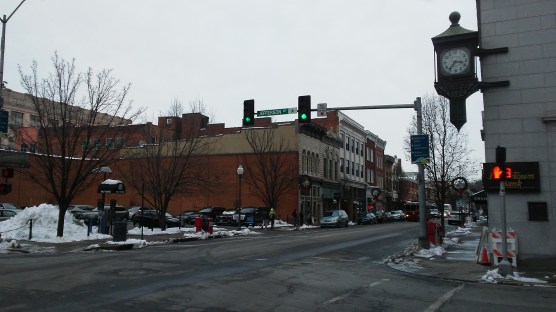
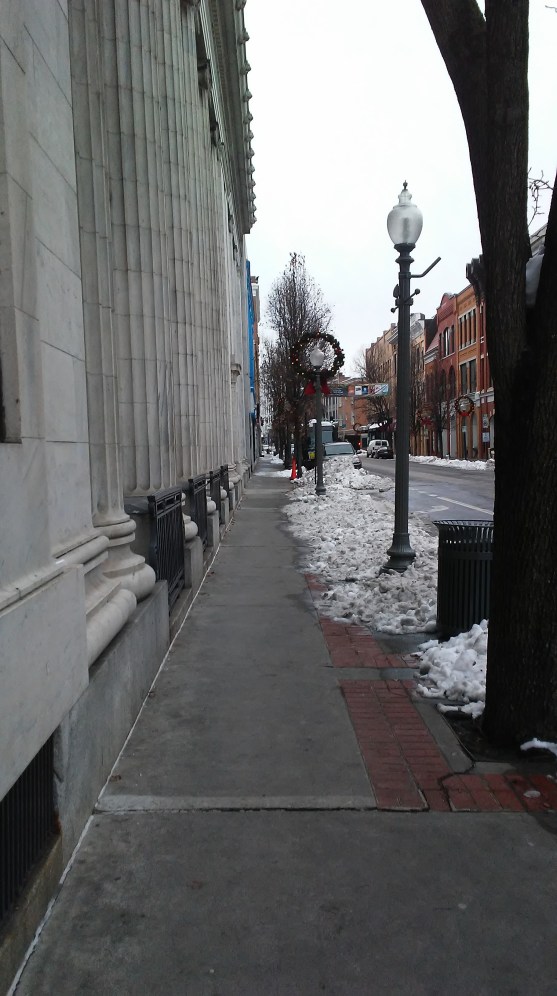
Roanoke, Virginia, December 2018

It’s the categorically quiet Southern city.  New Yorkers, this is midday during the holiday shopping season.

It’s an odd impression to get, but sometimes I feel as though I am walking through a university campus during Christmas break.  (All the buildings are there, but all the students are away.)

But when you do run into people, they are the friendliest and most cheerful that you could ever hope to meet.  I was just walking by and a local friend called out to me from her car on 1st Street.  I love this sleepy town.


20181212_153426

20181212_153526

Thus begins my illustrious career as an abstract filmmaker.

Pretty avant-garde, no?  I’m calling it “Snowfall.”  Bring on the accolades.  (You know how I always want ’em.)

I’m … actually not sure that I could fully define “avant-garde” if you put me on the spot without Google.  It’s a lot like “postmodernism” that way.

Anyway, this was the winter’s first snowfall here in Roanoke today, just two weeks ahead of Christmas 2018.  Look at the size of those flakes.   They are so big that you can actually hear them striking the ground.  I’m serious!  Play the video with the sound on!


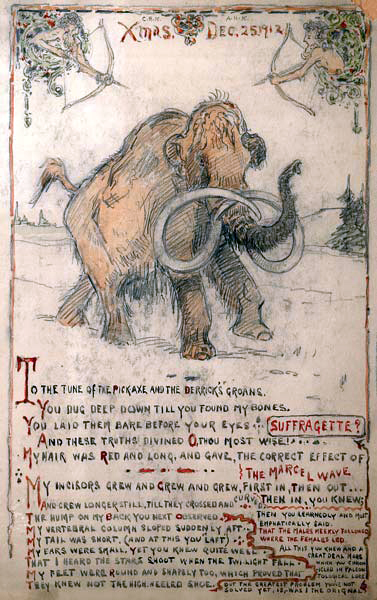
Because nothing says “Merry Christmas” like an undead woolly mammoth speaking in verse while cupids try to kill it.

Vintage Christmas cards are nuts, as anyone who’s ever gone down that particular Kafka-esque rabbit hole will tell you.  If you do a simple Google image search, you can see that our supposedly dignified forebears evidently toked up a lot around the holidays, whether it was on opium or bathtub gin or cocaine-fueled Coca-Cola or sassafras or whatever.

This might be the weirdest one yet.  The card below dates from 1912, and actually features a handwritten, rhyming poem –a lot of these antique holiday cards feature short, peculiar, rhyming poems; it was almost a folk-art genre unto itself.

Anyway, you’ll see that the poem below describes a woolly mammoth being excavated, and then … resurrecting or something.  (Or is this its ghost?)  The prehistoric animal has a creepy (though quaint and nicely vivid poem) addressing his saviors.  I’m pretty sure it’s about women’s suffrage, though I’m not sure whether it’s for or against.  I’m leaning toward the latter.  The poem gets harder to read toward the end, but … does it describe the female animals leading the males “meekly” to their long-ago death and entombment in the ice?  (And the author’s position is sort of implied by the one-word query, “Suffragette?” circled and written in blood-red letters.)

There are two cupids endeavoring to kill this unholy animal; you can find them in the top corners.  Because it’s a zombie, they are wisely aiming for its head.

“Merry Christmas,” in other words.

What is sassafras, exactly, anyway?  I can honestly you that I do not know for sure.


1912_Christmas_mammoth

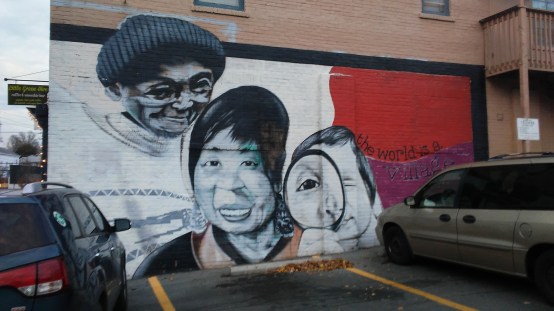
A cooling, gray Grandin day.

Grandin Village in Roanoke, Virginia. November 2018.

Pictured is Grandin Road.


20181129_164616

20181129_164918


“NOW YOU WILL WITNESS THE TRUE POWER OF DECEMBER 25TH!!”

Are any of you guys seeing what I am seeing with Melania Trump’s new White House Christmas display?


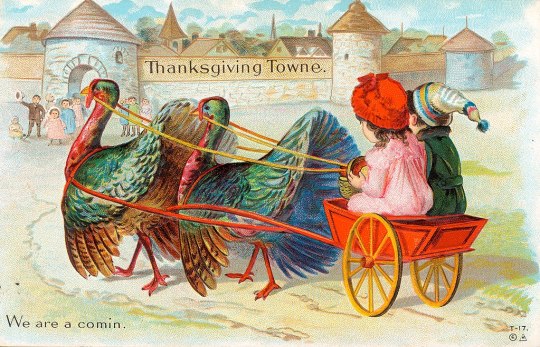
Happy Thanksgiving, all!

I hope that you and all you love enjoy a safe and happy holiday.


1024px-_Thanksgiving_Towne._We_are_a_comin._


Thank You, Veterans.

“Joseph Ambrose, an 86-year-old World War I veteran, attends the dedication day parade for the Vietnam Veterans Memorial in 1982. He is holding the flag that covered the casket of his son, who was killed in the Korean War.”

—  Department of Defense. Defense Audiovisual Agency; Scene Camera Operator: Mickey Sanborn