Tag Archives: AMC

A very short review of the Season 7 premiere of “American Horror Story” (2017)

I finally got around to watching my first episode of “American Horror Story” last night; I started with this season’s critically praised premiere.  (People have been enthusiastically recommending this show to me for years, and “Game of Thrones” taught me that the bandwagon isn’t always a bad thing.)

I can’t say that I was overly impressed.  Season 7’s opening episode, entitled “Election Night,” consists mostly of heavy-handed political commentary with caricaturized portrayals of both Donald Trump and Hillary Clinton supporters.  Nearly none of the characters are likable; not even the one played by the terrific Evan Peters.  (Yes, comics fans, that’s none other than Quicksilver from the latest “X-Men” movies.)

There is a lot of “scary clown” horror here, as anyone who’s seen any marketing for the show at all should know.  Between that and the political elements, I suspect I am not the right audience for this show.  I simply find clowns obnoxious instead of scary, and political commentary in horror usually falls flat with me.  (I’m the rare horror fan who loves George A. Romero’s work only because it’s scary, without caring much about the social statements he’s supposedly making.)

With all of that said, there actually were a couple of creepy moments late in the game.  And there was one (as of yet, minor) character that I liked — the child of the liberal couple who were so devastated by the election results.  He’s cute, and any kid who hides parentally forbidden horror comics under his pillow is one of my tribe.

I’d somewhat grudgingly rate this a 5 out of 10.

Anyway … scary clowns are ubiquitous now, and we already have the zombie shows we need.  I propose that we bring back … body snatchers.  Those can be terrifying in the hands of a talented writer, and they require no special effects.  Or, what about vampires?  Now that “The Strain” has concluded, how about a well written television excursion into Steve Niles’ “30 Days of Night” universe?  Or maybe a “Stakeland” TV show?  Looking at you, AMC.


4ca784d4bb33b763_ahs

A few quick words on the Season 3 premiere of “Fear the Walking Dead” (2017)

I’m going to go ahead and commit horror-nerd heresy here … at this point, I think I enjoy AMC’s “Fear the Walking Dead” more than “The Walking Dead.”  The characters feel more “real,” and the stories move far, far faster.

Last night’s first episode was a hell of a lot of creepy, disturbing, pathological fun — enough for me to give it a 9 out of 10.  And to make it a little cooler, we’ve got a couple of terrific “that guy” actors in supporting roles.  The first is “Band of Brothers” and “24” alumnus Ross McCall, the second is “The Following’s” Sam Underwood.

Good stuff!


A tiny review of “Stake Land II” (2016)

“Stake Land II” (2016) can’t match the magic of the original, but it’s still good enough to recommend, I guess.  I’d give it a 7 out of 10.  (I’m told that an alternate title is “Stakelander,” but I refuse to call it that, because it sounds too much like a spoof of either “Zoolander” or “Highlander.”)

This sequel has a direct-to-video feel to it.  Set a decade following the events of the original, the movie reunites Connor Paolo and Nick Damici, as the now-adult Martin and the enigmatic, vampire-killing powerhouse, “Mister.”  Paolo feels flat this time out, the movie is occasionally slow, and the action sequences are a little underwhelming.

Still, Damici shines.  And I couldn’t help but find myself engaged by the movie as a whole.  Even if the film isn’t a classic, the brutal, unflinching “Stake Land” fictional universe is still front and center.  The post-apocalyptic setting and character backstories are so dark and unpredictable that the film is still fun for a seasoned horror fan.  It’s at least as interesting as an average episode of AMC’s “The Walking Dead.”


stake-land-2-movie-poster

A few quick words on “What We Become” (2016)

“What We Become” (2016) is a competent, serviceable Danish horror film that nevertheless could have been better.  (The film’s original title was “Sorgenfri.”)  It’s capably written, nicely filmed, and well performed by its actors, and there is genuine suspense once its zombies are allowed to run amok.

The trouble is, that takes far too long.  Like America’s “Viral” (2016), this is a zombie movie that spends so much effort on its setup that there is little time left for enough payoff.

This is another thoughtful apocalyptic monster movie that pays a great deal of attention to the media and military response to the emerging crisis.  (And it’s creepily effective the way this is told exclusively from the point of view of a Danish suburb’s residents.)  It will hold your attention as a kind of “slow burn” horror film — it reminded me a little of the first season of AMC’s “Fear the Walking Dead.” Ultimately, however, the zombies get too little screen time.  And that’s a shame, because what we do see as a horrifying, tragic climax is actually very well executed.

Overall, I’d rate this a 7 out of 10.


large_fdm3dawxz9kkpg2gybnu0ui3gba

A review of “Goodbye World” (2013)

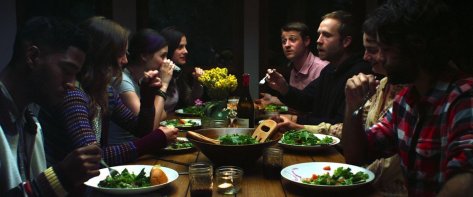
“Goodbye World” (2013) is technically a post-apocalyptic drama.  I say “technically” because this sometimes misguided movie contains little tension associated with its apocalyptic event.  (A cyber-attack destroys the technological infrastructure of America and possibly the world.)  Indeed, this catastrophe doesn’t even truly drive the plot — it’s more of a background subplot that fails to even affect the tone of the film.  (The poster you see below is misleading.)

Instead, the film scrutinizes the personal lives of a group of thirtyish college alumnae who have an informal reunion at a mountain cabin — one of their number is a plot-convenient intellectual-turned-survivalist.  They’re portrayed by an (admittedly quite good) ensemble cast.  I think a lot of my friends would smile at “Gotham’s” Jim Gordon (Ben Mckenzie) being a rather meek, feckless husband.  And Caroline Dhavernas here is no longer the alpha female we saw in NBC’s “Hannibal,” but is rather an insecure, overly sensitive young wife who immaturely pines that she was the student “everyone hated.”

And there lies a problem that the movie has … few of these characters are terribly likable.  Only Gaby Hoffmann’s surprisingly tough civil servant made me root for her.  And Kerry Bishe’s perfectly performed, chatty neo-hippy eccentric was also pretty cool … Bishe might have given the best performance in the film.  Finally, Linc Hand is a surprise standout, arriving halfway through in a menacing supporting role.  It’s a far smaller role, but damn if he doesn’t nail it.  (Please, Netflix, cast this guy as Bullseye in Season 3 of “Daredevil.”)

The others all seem either self-absorbed, self-righteous and preachy, or inscrutable and vaguely dumb.  Dhavernas’ character actually steals a child’s teddy bear (which she herself had brought as a gift) and … sets it free in the forest.  It was a belabored character metaphor when written.  Worse, it just seems jarringly weird when it plays out on the screen.

All the characters seem strangely detached about the watershed national or global crisis. Some cursory dialogue is devoted to the imagined welfare of their family, colleagues or other friends; the character interaction is devoted mostly to  marriage issues and personal emotional crises that I have mostly forgotten as of this writing.  And those seem maudlin and slightly selfish compared to the Fall of the United States.  The characters mostly failed at engendering viewer sympathy in me.

The screenwriters’ juxtaposition of personal matters and the end of the world also seemed tone deaf.  We follow what the writers hope are educated, successful and endearingly quirky fun people, and we’re asked to worry about their love triangles and spousal communication issues.  But … we’re then asked to view this in the context of a pretty frightening collapse of society, complete with plot elements that are interchangeable with those of AMC’s “The Walking Dead.”  (One secondary character turns violent over the issue of resources, then charismatically justifies his violence to  a crowd using a half-baked ideology that seems to channel “The Governor.”)

I felt like I was watching two movies at once, and not in a good way.  The opening motif is brilliantly creepy — the virus causes cell phones everywhere to receive a text reading the titular “Goodbye World.”  Our laconic, uniformly telegenic protagonists kinda just shrug at it.  And even when suspicions arise in the group about whether one character is connected to the cyber-attack, there is dry, dialogue-driven humor instead of any real consequent tension.  It was like John Hughes wrote a thirtysomething dramedy, but then tried unsuccessfully to sprinkle in the human pathos of one of George A. Romero’s more pessimistic zombie films.

But don’t get me wrong.  This wasn’t even really a bad movie.  I didn’t hate it.  It held my interest, its actors gave good performances, and I am a shameless fan of Dhavernas in particular.  The cinematography was very good too, and the story’s tonal differences were occasionally interesting.  (This is definitely a unique end-of-the-world tale, if nothing else.)

I’d honestly give “Goodbye World” a 7 out of 10.  I think my expectations sitting down with it were just unusually high, seeing Dhavernas attached to what looked like an independent, cerebral, apocalyptic science fiction thriller.  I might even recommend it if you’re in the mood for a really unusual doomsday movie.  Just don’t expect “28 Days Later” (2002) or “The Divide” (2012), and you might like this.


Goodbye_World_Theatrical_Poster

hero_GoodbyeWorld-2014-1

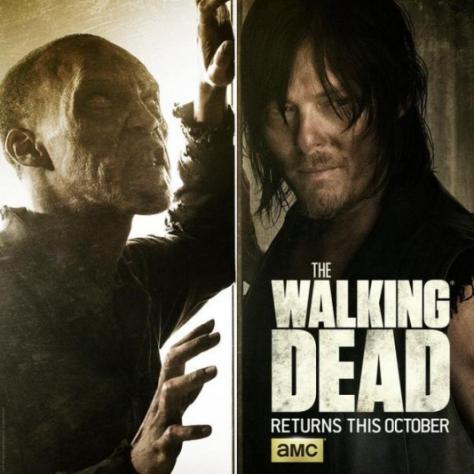
My review of “The Walking Dead” Season 6

Season 6 of “The Walking Dead” ended terribly last Sunday night, with a gimmicky, redundant, cartoonishly filmed cliffhanger that seemed like a power trip for the show’s writers and a shameless trick to ensure ratings for the Season 7 premiere.  Even that blunder, however, can only partially mar an otherwise great season of television; I’d still give the sixth season a 9 out of 10.

Seriously, Sunday night’s closing minutes were a big disappointment. We did not — I repeat, we did NOT — get to see which of our heroes would fall victim to new arch-villain Negan and his barbed-wire baseball bat, “Lucille.”  (I don’t think that I’m writing a spoiler here, as I’m informing the reader of an event that was not yet depicted.)  We get to see the dramatic and frightening events leading up our heroes’ capture — overall, the episode was pretty good, I think.  And we get to see some iconic images and hear dialogue that we remember from the original comic series.  And we finally get to see Jeffrey Dean Morgan appear as the new big-bad, something the show’s marketing suggests AMC believed fans would be happy with alone.

But the season ended with a cheesy point-of-view shot of the nameless individual who Negan executes, then a black screen along with the muffled screaming and shouting of those protagonists who are left to witness their friend’s murder.  (Check Youtube — some pretty ardent fans have actually analyzed the sounds and provided subtitles, supposedly providing clues as to who the victim was.)  And the manner in which it was filmed was kitsch — it reminded me of the over-the-top POV shots employed by Sam Raimi.

I think this is poor storytelling.  The Saviors storyline has been building for at least half a season (earlier if you consider the first encounter with Dwight), and the death of one of our heroes was the universally expected, logical conclusion of that.  The cliffhanger also felt like a little bit of a “f*&% you” to the fans.  The show’s creators know that its viewership was so eagerly anticipating an answer to the million-dollar question — “who dies?”  And they showed us that not only have they enjoyed stringing us along, they’re going to enjoy gratuitously stringing us along for another seven months until Season Seven.

And, hey, it looks as though this parsimonious storytelling will be the case with tie-in promotions as well.  I read today over at Hollywood Reporter that Robert Kirkman has produced a 48-page comic containing Negan’s backstory.  As you may read at the link below, however, only four pages at a time will be made available to fans, as they are released monthly in a comics preview catalog, “Image +.”  (And I’m unclear about whether readers will have to pay for that.)  C’mon.  Gimme a break:

http://www.hollywoodreporter.com/live-feed/walking-dead-see-first-page-881581

Furthermore, the final scene was a little problematic in other ways.  I liked Morgan’s performance, but I he didn’t knock my socks off as he apparently did for other fans.  The monologue scripted for him was far too long.  Much of it is lifted from the comics; I think that a lot of it did not translate well from page to screen.

Finally, the cliffhanger was redundant — didn’t the season’s penultimate episode also tease a major character death in its final seconds, employing a cheap visual trick to obscure this person’s fate?

Ah, well.  Like I said, I think Season 6 actually was stellar.  We hardcore fans tend to criticize our show a lot (hence my bitching above).  Our criticisms are often well deserved, but I think we might have been spoiled a bit by “The Walking Dead.”  After six years, five of which were downright addictive, it’s easy to lose sight of how groundbreaking the show has been.

There has never been anything else like it on television.  The fact that it’s the first real zombie apocalypse serialized horror show is obvious, along with its new levels of gore, pathos and goddam amazing makeup effects.  But think also about its breadth and scope — since Season One, I think it’s gone to great lengths to tell an epic story.  Budget constraints — including a limited range of shooting locations in rural southern Georgia — restrict it somewhat.  But like no other show before it, it portrays a horrifying apocalypse from the points of view of a very broad and constantly changing ensemble of characters.

Sometimes this broad and changing ensemble works against the show.  I think one of its weaknesses is that it sometimes doesn’t feel like a well crafted, deliberate story at all, but rather a kind of “reality show” like “Survivor” (2000 – 2016).  Instead of watching in suspense to see who is “voted off the island,” we instead watch in suspense to see whether our favorite fictional character meets a grisly end.  I wouldn’t be surprised if people placed bets.  (I’ve heard that people indeed used to bet on “Survivor” in Las Vegas.)  Consequently, it feels more like bread-and-circuses than real meaningful storytelling within a post-apocalyptic context.

But “The Walking Dead” still manages to be damned good.  Early on in Season 6, I commented to another fan that the show actually seems to be getting better.  It’s getting smarter, with more ideas, and greater attention to detail.  I honestly get the sense that its writers sit down and think about the plausibility and logistics of various elements of this imaginary world.

It has essentially become a war story, even when it’s often just a neverending war of attrition with a universal enemy.  The writers grasp this, and they pick up the ball and run with it.  Attention is paid to strategy, logistics, leadership, morale, levels of training and commitment — Rick’s grand plan to lead the newly released “herd” away from Alexandria in the season’s earliest episodes is a great example of this.

And there is far more world-building.  Based on my familiarity with the comic book series, I recently advised another fan that the entire structure of the show would change.  Instead of people moving place to place and negotiating the various threats there, we now see stationary groups of survivors either fighting or cooperating with one another’s societies — something we’ve previously only really seen with The Prison vs. Woodbury.  This creates a range of larger, more layered and interesting storytelling possibilities.  And there are more enclaves even than we’ve seen so far.  (I’m trying to keep this spoiler free.)

Complementing this new change in story structure are elements of the show that seem to have improved even further.  The action and suspense have increased greatly.  I found myself on the edge of my seat during a few episodes — the one that comes to mind is when our heroes invade the satellite station.

The horror elements are new and stronger.  Story arcs involving the Wolves were extremely unsettling.  (I myself wanted far more of that bizarre little clutch of psychopaths.  Are they a cult?  Do they have a coherent ideology?)  The Saviors, whose survival skills and competence match or exceed Rick’s group, are frightening, especially for those of us who are already acquainted with them through the comics.

I even find I like the show’s drama better in this and recent seasons — more so than in the show’s early years.  Yes, the sad, unsupported, inexplicable recent character change in Carol was a disastrous choice.  And Abraham’s love triangle was a mostly inscrutable nod to the comics.  But there were a lot of other good things to be found this season — Morgan’s backstory, Nicholas’ character arc, the arrival of Jesus and the outcome with Denise.

All told, it was a great season.  Maybe someday a DVD special edition can rectify its final minutes, and supply a necessary face for Negan’s anonymous victim.  Hey, the show obviously wants to milk each cow for all it’s worth, right?
 

daryl-will-be-back-to-face-off-against-the

Season 1 of Netflix’ “Daredevil” was downright superb!

Throughout the entire first season of Netflix’ “Daredevil,” the obsessive comic book nerd in me kept scanning outdoor scenes for The Avengers Tower.  I don’t think I saw it once.  But that didn’t affect my enjoyment of a serial crime thriller that was so often fantastic.

And I think that sums up the program nicely.  This is only a putative part of the Marvel Cinematic Universe.  References to the fantastical larger universe of Marvel’s comic book movies are perfunctory and vague.  The intergalactic invasion of the Chitauri lizard-men, engineered by the Norse God Loki, is referred to only as “the event” — even though the destruction in New York is part of this season’s plot setup.  Characters like Iron Man and Thor are referred to dryly by a secondary bad guy who doesn’t even mention their names.  And other “comic book connections” tend to be minor, obscure, and sparing for a 13-episode season.  I actually gained the suspicion here that the screenwriters for this brutal crime drama were unconsciously embarrassed that their show was part of the MCU.  Yes, I do know that Netflix will soon launch other related shows, for less iconic comic book characters such as Luke Cage and Iron Fist, and that this incarnation of Daredevil seems fated to join something called “The Defenders.”  (Ugh.)  But that thankfully hasn’t happened yet.

Even the comic book elements of the Daredevil mythos seemed to me to be underplayed here.  His unusual powers (they don’t even feel like “superpowers”) rarely take center stage.  His villains aren’t garish. He’s only nicknamed “Daredevil” via a news article in the final episode; nor does he don anything approaching his trademark costume until then.  Wilson Fisk, our Big Bad, is never once referred to by his comic book appellation, “The Kingpin.”

And you know what?  All of that works just fine.  The Hell’s Kitchen we see in “Daredevil” might seem like a universe unto itself.  But, given this show’s quality, even a diehard comic book fan like me can concede, “if it ain’t broke, don’t fix it.”

It ain’t broke.  I’d rate Season 1 at a 9 out of 10.  In many ways, “Daredevil” is far superior to anything else in the MCU.  This show’s distinguishing characteristic isn’t that it’s dark.  It’s that it’s a well written, well directed, and usually quite well performed crime-thriller.

It has surprisingly three-dimensional, truly interesting characters who are rendered in depth and detail.  This includes a few bad guys, by the way, who might have a knack for winning over viewer loyalty just by being so good at being bad.  (Most people would point to Fisk, but for me, Wesley was the guy you hate to love.)  Many characters are so well written and played by their actors that they seem 100 percent “real” — particularly Ben Urich and Karen Page.  This is the single MCU property with the most compelling characterization and, yes, I am including the “Iron Man” films in this comparison.

Yes, everything you’ve heard about this being Marvels darkest onscreen outing is correct … and THEN some.  The story is not just thematically dark; the story is itself brutal.  This seems to be a corner of the MCU in which the harshest consequences result for characters at every level.  Daredevil doesn’t just “take a hit” here; he gets cut up, bloodied and scarred — so much at several points that he requires the services of a (regrettably plot convenient) off-duty emergency room nurse.

Far worse is what happens to ordinary people who are heroic themselves.  No good deed goes unpunished in this nasty niche of Marvel’s world.  Defenseless people are shown no mercy by the story’s stronger protagonists.  The murder of one beloved character is all the more chilling because we witness their fruitless attempts to defend themselves despite a complete absence of special powers or training.  It’s … actually a bit worse than what we saw in that paragon of gritty superhero films, Christopher Nolan’s “Dark Knight” trilogy.

And the crimes and criminals themselves?  Yeesh.  An early scene in the very first episode gives us a chilling little glimpse of human trafficking, with sobbing, kidnapped women loaded into the back of a dockside shipping container.  Not long after, we witness a father being beaten in the street before his son’s eyes; the child is then snatched.  The running theme here is that ordinary human evil can be more terrifying than dimension-hopping lizard-man armies or tyrannical Norse gods.  Sure, this theme is something we’ve seen plenty of times before.  But here, it’s just done so damn WELL.

The fight choreography was frikkin’ SWEET.  It was fantastic enough to be comic book violence, but gritty and consequential enough to be real-world violence.  I kept trying to figure out where a stunt double might be filling in for Charlie Cox, who portrayed Daredevil.  I couldn’t.  He’s … not doing his own stunts, is he?

The acting was usually quite good.  Deborah Ann Woll consistently stole the show as Karen Page — the script here beautifully elevates Karen beyond her pretty pathetic comic book incarnation.  (A caveat — I was reading the “Daredevil” comics in the 1990’s, and am using those as a frame of reference here; of course they might have changed significantly since then.)  Karen often seems to emerge as much of a primary protagonist here as Daredevil himself.  She’s got far more at stake, personally, and Woll expertly gets that across to the audience.  And she’s a complex character, playing the fool for Foggy Nelson, being the the darkly driven de facto apprentice to Ben Urich, and occasionally being manipulative and ruthless in ways that our other protagonists never could.  What a great improvement on the original source material.  (Hint — comics are not a medium known for its feminist sensibilities.)  Woll, who I remember hitting it out of the park in her psychopathic role in HBO’s “True Blood” (2008) outshines every co-star.

Nearly every other cast member was perfect or near perfect.  Vondie Curtis-Hall needs special mention here for truly bringing Ben Urich to life on the big screen for the first time.  His turn as the aging, jaded newspaper reporter was flawless.  Urich, to me, will always be the greatest reporter in comics.  (F&*$ Peter Parker and those Daily Planet pretty people; Ben was the real deal.  Who cares if he was past mid-life?  He was the only character in the comic books who spoke and proceeded like a real journalist.)

There were really only a couple of forgivable weaknesses that affected my enjoyment of Season 1.

First, the narrative structure … seemed “off” somehow.  I see the basic underlying story here as ultimately being an deeply personal battle between two men: Daredevil and the Kingpin.  (This is despite the way that Karen and Ben delightfully distinguish themselves as prime movers in the plot.)  I …. never really sensed any momentum here.  For a while, Daredevil and Fisk have minimal information about each other.  We see Matt Murdoch in skirmishes with many underlings; these seem episodic and without greater consequence.  Then … Matt quite accidentally meets Fisk for the first time, when he tries to “get a sense of” his enemy by … meeting his girlfriend?  Huh?  I never really got a sense of these two primary characters moving toward each other until the last episodes.  Oh, well … the comics were kinda like that.  But I do hope that future seasons are more tightly plotted, with more consistent tension.

Second, there really seemed to be multiple problems connected with the character of Foggy Nelson.  I do think that Eldon Henson performed quite poorly in the role.  Maybe he was just miscast.  He doesn’t once come close to the performances of his co-stars.  I also think the script did absolutely nothing to make Foggy a likable character.  He’s immature, self-absorbed, and ethically rickety.  His jokes fall flat; his flat “banter” with Karen is grating (and makes her look like an idiot).  He’s … downright irritating.  Why would Matt want him as a “best friend” or business partner?  Why would anybody?

Third, I occasionally would like a more specific nod in Hell’s Kitchen to the larger Marvel universe.  Maybe a truck passes by with the Stark Industries log.  Maybe a kid passes by with a Captain America t-shirt.  Maybe a couple of S.H.I.E.L.D. agents investigate Fisk’s employees in connection with offshore partners who are alleged to have super-powered henchman.  Just something small — it wouldn’t spoil the “real” feel of our dark drama, and it would place our protagonists’ lives in a larger context.

All in all, though, “Daredevil” was surprisingly superior to what I thought it would be, even with all of its glowing press.  See it.

One final note — if you’re a fan of both superhero comics and AMC’s “The Walking Dead,” then Season 2’s casting has a wicked cool surprise, if you haven’t already heard about it.  Head on over to The Internet Movie Database to see who is playing whom.  You’ll smile.

Poster-Season-One-daredevil-netflix-38398364-680-1000

No, “The Walking Dead” is not filming in Wytheville, Virginia.

No, AMC is not planning on filming in Wytheville, Virginia.  The item that’s been popping up recently on Facebook is a hoax.

If you type the homepage feednewz.com in your browser, it actually redirects you to a site called prank.link, where ready-made hoaxes can be shared via Facebook.  I’d say that the whole thing is in questionable taste, but then, I’ve been known to pull a prank or two myself via this blog.

Just one more week!!

We are “NEAR THE WALKING DEAD.”

AMC’s marketing job is doing a bang-up job.  These posters are terrific, as was the full-length trailer.

Fear The Walking Dead Comic Con Art - Fear The Walking Dead _ Season 1, Comic Con Art - Photo Credit: Frank Ockenfels 3/AMC

fear-the-walking-dead