That awkward moment after you get a haircut at the mall and you say “You’re a handsome rogue” to yourself in the men’s room mirror, but it turns out there was a guy in one of the stalls who probably overheard you.
That awkward moment after you get a haircut at the mall and you say “You’re a handsome rogue” to yourself in the men’s room mirror, but it turns out there was a guy in one of the stalls who probably overheard you.
Ghosts seldom scare me, because I’m never 100 percent clear on what sort of threat they present to the protagonists of a horror film or TV show. They’re not like zombies, vampires, werewolves or serial killers, all of which will do predictably horrible things to their victims.
Can ghosts … kill you? Injure you? That usually doesn’t make sense, given their non-corporeal nature. Can they … scare you to death? How would that work? Would they cause a heart attack? Or drive you mad? That’s fine, I suppose, but here they’ve taken a back seat to the demons of horror films since 1973’s “The Exorcist” spawned a sub-genre with far more frightening supernatural baddies. Are ghosts supposed to inspire existential dread, by reminding the viewers of their own mortality? For me, that backfires — their existence would strongly suggest the existence of an afterlife, which would be paradoxically reassuring.
It’s therefore a testament to the quality of Netflix’ “The Haunting of Hill House” (2018) that it’s frequently so scary, even to me. We find out in the first episode that its ghosts indeed do more than frighten the story’s protagonists, but it’s the show’s writing, directing and acting that make it so memorable. It’s an a superb viewing experience, and I’d rate it a 10 out of 10.
The cast roundly shines — but especially Carla Gugino and Timothy Hutton (even if his performance was a little understated). Catherine Parker is deliciously evil in a supporting role as the house’s most outwardly vicious spirit. The best performance, for me, however, was the young Victoria Pedretti as the traumatized Nell — she was goddam amazing, and deserves an Emmy nomination.
Mike Flanagan’s directing was perfect — his use of long angles and colors to make lavish interiors disorienting reminded me of Stanley Kubrick’s similar sensory trickery in “The Shining” (1980). Michael Fimognari’s cinematography was beautiful. Even the makeup effects were damned good. (Nothing beats Greg Nicotero’s work in “The Walking Dead” universe, but the work here is sometimes horrifying.)
I’m not the only one who loved this show either. It is broadly praised in online horror fan circles (though I’d recommend avoiding most of those for spoilers). I haven’t read Shirley Jackson’s 1959 novel that is its source material, but a bibliophile who I trust assured me that the show is even better.
Sure, there were some things that didn’t work for me. “The Haunting of Hill House” actually does take a while to get where it’s going; it favors in-depth, flashback-heavy character development over advancing its plot, in much the same manner as “Lost” (2004 – 2010) once did. And some viewers might feel the same frustration here as they would for that show.
Its story and supernatural adversaries are also distinctly Gothic. (Your mileage may vary as to what’s a comfortably familiar trope and what’s an archaic cliche. I myself was more interested the more modern and three-dimensional interpretation of ghost characters seen in 1999’s “The Sixth Sense.”) I’d even go so far as the say that the first ghost that we see in any detail is actually disappointing — the otherworldly figure connected with the bowler hat felt too cartoonish for me, like something we’d see on Walt Disney World’s “The Haunted Mansion” ride. (Trust me, they get more intimidating after that.)
Give this show a chance — and stay with it if you think it’s too slow, or if you find its characters a little unlikable at first. You’ll be glad you did.
Weird world: if the diffident, sometimes off-putting character of Steven looks familiar to you, it might be because that’s none other than Michiel Huisman, who plays the charismatic Daario on “Game of Thrones.”

It’s the categorically quiet Southern city. New Yorkers, this is midday during the holiday shopping season.
It’s an odd impression to get, but sometimes I feel as though I am walking through a university campus during Christmas break. (All the buildings are there, but all the students are away.)
But when you do run into people, they are the friendliest and most cheerful that you could ever hope to meet. I was just walking by and a local friend called out to me from her car on 1st Street. I love this sleepy town.


I happened across this video last night from Youtube user RAVN52AOL, and just had to share it. It’s six minutes long, and it’ll really take you back when your old favorite toy comes up in the montage. I think it’s the Duran Duran song that really ties the whole thing together. [UPDATE: I have just been indignantly informed by another 80’s kid that the song is by Simple Minds — not Duran Duran!! Apologies!!]
Tonka Trucks — I haven’t heard those mentioned in a long time (although, admittedly, they were around for a looooong time before the 1980’s). My best friend next door had a fleet of the big metal things; they were always scattered around the bulky square sandbox that his Dad built for him in his backyard. That kid loved his Tonka trucks.
I’m honored today to see The Piker Press publish my time-travel horror story, “Shine Now, Fiercely, Forever.” It’s a cautionary tale about two married scientists whose newly invented time machine delivers them to both a hellish end and an endless hell. (Seriously, people, use your time machines carefully.)
I am quite grateful to Editor Sand Pilarski for graciously allowing me to join The Piker Press’ wonderful creative community. It really is a wonderful weekly online journal of arts, sciences, fiction and non-fiction, and I encourage you to visit the site.
If you’d like to find my story, it is on the cover of The Piker Press right here.
Enjoy!

The first step is admitting that you have a literacy problem.
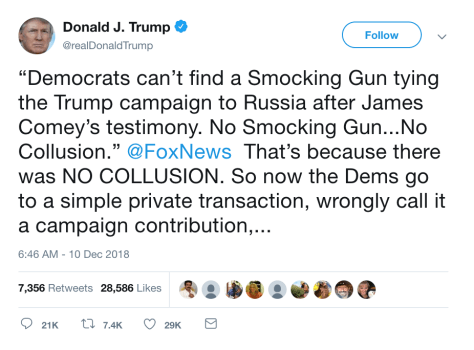
So, the moral of the story is … “Dont tweeet while smocking teh hard stuf?”
It’s so weird having a president that consistently resembles the former character in those old “Goofus and Gallant” comic strips.
Oh god, I probably just dated myself with that reference.
Pretty avant-garde, no? I’m calling it “Snowfall.” Bring on the accolades. (You know how I always want ’em.)
I’m … actually not sure that I could fully define “avant-garde” if you put me on the spot without Google. It’s a lot like “postmodernism” that way.
Anyway, this was the winter’s first snowfall here in Roanoke today, just two weeks ahead of Christmas 2018. Look at the size of those flakes. They are so big that you can actually hear them striking the ground. I’m serious! Play the video with the sound on!
This was another book during my grade-school days that really fed my excitement about monsters — Jerry A. Young’s 1983 children’s book, “Movie Monsters From Outer Space.” (Why does the author’s name sound so much like a pseudonym to me?)
I’m sure it’s obscure by now. If memory serves, this was another title I ordered from those classroom bulletins put out by Scholastic Book Clubs. (I was in the third grade, I think.) It gave kids a brief, fun run-down of a bunch of space-based baddies — those are the Cylons from the original “Battlestar Galactica” (1978) on the cover.
It featured a bunch of older B-movies too. I remember really wanting to see “Forbidden Planet” (1956) after seeing a picture of its monster there.
I also seem to remember reading about Ridley Scott’s original “Alien” (1979), although I suppose that I could be recalling another book. (It would be odd if Scott’s masterpiece were described here, because it was … kinda not for kids.)


It is the only possible explanation for their bizarre greeting cards. (Just one more post about this, I promise.)
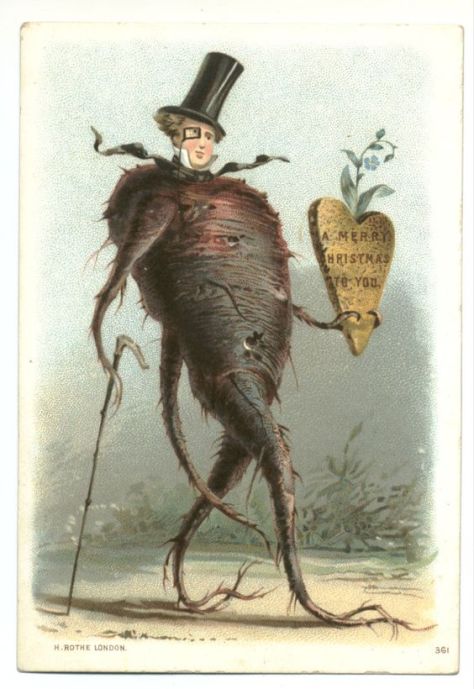
The card below is from the Victorian era. It features an apparently affluent … turnip man. Who wishes the reader “a Merry Christmas” with handheld stone tablet shaped like a heart. (Is it a tombstone? Why is their a flowering plant growing out of it?)
Now … if I had been this card’s creator, I would have at least added, “I hope all sorts of good things turnip for you in the New Year.” Because that’s how I roll.
I have been interacting online with a few Donald Trump supporters about Democrats’ desire to repeal the House of Representatives’ 1837 rule against hats on its chamber floor. The move comes in response to the unprecedented election of two Muslim women to the House, and is intended to allow them to wear their traditional religious headwear. (The 19th Century rule itself has little to do with religion, and simply forbids hats outright.)
Some of the Trump supporters are expressing their objections civilly, and some of them a bit less so, but their message is the same — that the Democrats’ desired change would be a breach of separation of church and state. Their broader (and apparently quite popular) argument is this — Democrats support separation of church and state when it comes to “purging God” from the public schools, but then ignore the concept when presented with an opportunity to shoehorn “ISLAM” (gasp!) to the halls of Congress.
This argument is poor. I am not a Democrat, and I do not presume to speak for them. But I am a separation of church and state supporter, and I will try here to briefly speak to that.
1) The American principle of law known as “separation of church and state” has nothing to do with promoting or “purging” any religion. The term was coined by Thomas Jefferson to describe one of the First Amendment’s key purposes — to keep a civil government and religious institutions separate, so that neither can perniciously affect the other. Its proponents (which ought to include every American) do not necessarily claim that any religion is good or bad — they merely claim that all religions should be kept separate from a government that is meant to serve all of their various constituencies. It is the best recipe for fairness, and I believe firmly that it is an important firewall against the United States becoming a theocracy.
And yes, evangelical skeptics, I do realize that the words “separation of church and state” do not appear verbatim in the text of the First Amendment. This shouldn’t matter, as the First Amendment’s text speaks succinctly enough itself on the matter: “Congress shall make no law respecting an establishment of religion, or prohibiting the free exercise thereof…” (That sounds pretty straightforward to me.)
And the words are indeed Jefferson’s — he coined the term when writing about the First Amendment, in an 1802 letter to the Danbury Baptist Association. Its text is clear:
“Believing with you that religion is a matter which lies solely between Man & his God, that he owes account to none other for his faith or his worship, that the legitimate powers of government reach actions only, & not opinions, I contemplate with sovereign reverence that act of the whole American people which declared that their legislature should “make no law respecting an establishment of religion, or prohibiting the free exercise thereof,” thus building a wall of separation between Church & State. Adhering to this expression of the supreme will of the nation in behalf of the rights of conscience, I shall see with sincere satisfaction the progress of those sentiments which tend to restore to man all his natural rights, convinced he has no natural right in opposition to his social duties.”
2) Saying that a legislator wearing a religious scarf is a violation of separation of church and state (and comprises a government endorsement of religion) is an incredible reach. By that logic, members of Congress shouldn’t be allowed to wear crucifixes as pendants or lapel pins either. Or … let me try a different example. Suppose that a Christian legislator wore a cap or a t-shirt depicting a crucifix. It would be silly for me to claim that this was a government endorsement of Christianity. Modes of personal dress do not represent an effort by their wearers to force religion on the rest of us.
Furthermore, proscribing these modes of dress could easily be perceived as a violation of the wearer’s individual First Amendment rights. (It is my understanding that Democrats are characterizing this prohibition — reasonably, I think — as a violation of the First Amendment’s protection of freedom of religion.) I would also entertain the idea that it violates freedom of speech as well.
3) Comparing a head scarf with the issue of mandatory prayer in the public schools is a tremendous false equivalence. One concerns what one member of Congress can wear on her head. The other concerns whether a religious schoolteacher can force all public school children under his or her charge to pray. The former consists of one person “participating” in a religion (inasmuch as modes of dress denoting affiliation are seen as “participating.”) The latter consists of one person (quite literally) forcing others to participate.
4) If prayer in the public schools is what Trump supporters are truly so concerned about, then they can relax. We already have prayer in the public schools — student initiated, voluntary prayer. What we do not have is mandatory, teacher-led prayer in the public schools. Students are free to pray. Public school students are also free to refrain from prayer, whether or not the teacher is happy with that. This best ensures that the rights of religious people are protected, while the rights of non-religious people are also protected. Doesn’t that sound fair?
5) This is admittedly a silly argument, but … a rule against hats? Does Congress really need that? Let the new Muslim legislators wear their head scarves. Let Christian legislators wear hats depicting Christian symbols, if that is what they would like. Let the Trump supporters wear MAGA caps. Let a dude wear a cowboy hat. Let me wear my “Deadpool” cap (when you are all finally wise enough to elect me to Congress). Everybody should just get down with their bad selves and be cool. We’re Americans, not the 18th Century House of Lords mincing around Queen Anne. Let freedom of expression take precedence over propriety.
 Eric Robert Nolan, Author