Tag Archives: Netflix

A short review of “Bird Box” (2018)

Netflix’ “Bird Box” generally pleases — I’d rate it an 8 out of 10, and I’d recommend it to anyone looking for a creative and effective apocalyptic horror film.  A few reviewers call it a “high-concept” horror movie because of its MacGuffin — an invasion of otherworldly beings causes anyone who looks at them to hallucinate and become suicidally depressed.  (A handful of survivors escape the chaotic mass suicides because they are lucky enough not to lay eyes on the mysterious, mind-bending creatures which can become images of their victims’ worst fears.)

It’s a hell of a setup — it reminds many people of this year’s “A Quiet Place” and 2008’s unfairly maligned “The Happening.”  (Hey, I really liked that movie.)  For some reason, “Bird Box” reminded me of the 1985 “The Twilight Zone” episode, “Need to Know.”  (It’s a great ep.)  And the plot device pays off — “Bird Box” is genuinely unsettling, and the whole story comes across as a blackly inventive end-of-the-world tale.

Sandra Bullock is good here; supporting actors Sarah Paulson and John Malkovich are even better. (Malkovich is mesmerizing whenever he plays an intense or unpleasant character.)

The film suffers somewhat from puzzling pacing problems — sometimes the story appears to be unfolding too quickly, but by the end of the two-hour movie, it feels too long.  “Bird Box” was adapted from a structured 2014 novel by Josh Malerman; I strongly get the sense that it tries to squeeze too much of its source material into a the running time for a movie.  I honestly think I would have enjoyed it much more if its frightening plot device and interesting, well-played characters were explored in a mini-series.

There’s another disappointment too — we learn very little about the story’s antagonists, beyond one character’s hypothesis that they’re archetypal punishing figures from a number of the world’s religions.  I wanted to know more.


Bird_Box_poster

A review of Season 1 of “The Haunting of Hill House” (2018)

Ghosts seldom scare me, because I’m never 100 percent clear on what sort of threat they present to the protagonists of a horror film or TV show.  They’re not like zombies, vampires, werewolves or serial killers, all of which will do predictably horrible things to their victims.

Can ghosts … kill you?  Injure you?  That usually doesn’t make sense, given their non-corporeal nature.  Can they … scare you to death?  How would that work?  Would they cause a heart attack?  Or drive you mad?  That’s fine, I suppose, but here they’ve taken a back seat to the demons of horror films since 1973’s “The Exorcist” spawned a sub-genre with far more frightening supernatural baddies.  Are ghosts supposed to inspire existential dread, by reminding the viewers of their own mortality?  For me, that backfires — their existence would strongly suggest the existence of an afterlife, which would be paradoxically reassuring.

It’s therefore a testament to the quality of Netflix’ “The Haunting of Hill House” (2018) that it’s frequently so scary, even to me.  We find out in the first episode that its ghosts indeed do more than frighten the story’s protagonists, but it’s the show’s writing, directing and acting that make it so memorable.  It’s an a superb viewing experience, and I’d rate it a 10 out of 10.

The cast roundly shines — but especially Carla Gugino and Timothy Hutton (even if his performance was a little understated).  Catherine Parker is deliciously evil in a supporting role as the house’s most outwardly vicious spirit.  The best performance, for me, however, was the young Victoria Pedretti as the traumatized Nell — she was goddam amazing, and deserves an Emmy nomination.

Mike Flanagan’s directing was perfect — his use of long angles and colors to make lavish interiors disorienting reminded me of Stanley Kubrick’s similar sensory trickery in “The Shining” (1980).  Michael Fimognari’s cinematography was beautiful.  Even the makeup effects were damned good.  (Nothing beats Greg Nicotero’s work in “The Walking Dead” universe, but the work here is sometimes horrifying.)

I’m not the only one who loved this show either.  It is broadly praised in online horror fan circles (though I’d recommend avoiding most of those for spoilers).  I haven’t read Shirley Jackson’s 1959 novel that is its source material, but a bibliophile who I trust assured me that the show is even better.

Sure, there were some things that didn’t work for me.  “The Haunting of Hill House” actually does take a while to get where it’s going; it favors in-depth, flashback-heavy character development over advancing its plot, in much the same manner as “Lost” (2004 – 2010) once did.  And some viewers might feel the same frustration here as they would for that show.

Its story and supernatural adversaries are also distinctly Gothic.  (Your mileage may vary as to what’s a comfortably familiar trope and what’s an archaic cliche.  I myself was more interested the more modern and three-dimensional interpretation of ghost characters seen in 1999’s “The Sixth Sense.”)  I’d even go so far as the say that the first ghost that we see in any detail is actually disappointing — the otherworldly figure connected with the bowler hat felt too cartoonish for me, like something we’d see on Walt Disney World’s “The Haunted Mansion” ride.  (Trust me, they get more intimidating after that.)

Give this show a chance — and stay with it if you think it’s too slow, or if you find its characters a little unlikable at first.  You’ll be glad you did.

Weird world: if the diffident, sometimes off-putting character of Steven looks familiar to you, it might be because that’s none other than Michiel Huisman, who plays the charismatic Daario on “Game of Thrones.”


HauntingHillHouse-tp0004c_Double_Gate_Cover_houseback

Throwback Thursday: “Don’t Be Afraid of the Dark” (1973)

I was only a baby when ABC debuted the original “Don’t Be Afraid of the Dark” in 1973, but I caught it when it was rebroadcast around the end of the decade, when I was … six or seven years old?  And dear GOD did it scare the crap out of me.

Since then, it’s become a minor legend in the horror fan community as one of the rare made-for-television movies that is easily as scary as something you’d see in a theater.  This was the film that was remade in 2010, produced by Guillermo del Toro and with Katie Holmes in the lead role.  (And I thought that the remake was a fun horror fantasy, even if it wasn’t terribly scary.)

I actually caught the film again about ten years ago, courtesy of Netflix’ DVD-by-mail service.  And it was still creepy enough.


Throwback Thursday: WOR-TV Channel 9’s “Million Dollar Movie” intro!

This will probably be a pretty obscure Throwback Thursday post, but the segment below should be recognized by people who grew up in the New York metropolitan area in the late 1970’s and early 1980’s.  It’s none other than the intro for WOR-TV Channel 9’s “Million Dollar Movie.”  (That music you hear is a particularly brassy rendition of Max Steiner’s “Tara’s Theme” from 1939’s “Gone With the Wind.”)

If you were in the New York area at that time, it ought to bring back memories of the old days of broadcast television.  (It’s actually surprising how much nostalgia people online report at seeing this 44-second clip.  And it’s amazing what you can find on the Internet.)  A few commenters note sardonically that the clip makes Manhattan look like a nighttime paradise — while The Big Apple in the 1970’s was not always an easy place to be.  (The city if far cleaner and safer today.)

Some of the comments I read were befuddling.  There is one blogger who wrote that he remembers this intro from as far back as the 1950’s.  (Had they really used it for more than two decades?)  And a populous minority of commenters remember being unsettled by the clip.  (They describe it as ominous, and the music as creepy, which mystifies the rest of us who remember “Million Dollar Movie.”)

This intro had an indelible effect on me.  While it recalls monster movies like “King Kong” (1939) and “Godzilla” (1954) for a lot of others, it will always remind me of my father watching war films and cowboy movies on his days off — along with the occasional Charles Bronson flick.   “The Great Escape” (1963), “A Bridge Too Far” (1977) and “Shane” (1953) all spring to mind.

When I was in the first or second grade, I habitually enhanced my Dad’s enjoyment of the “Million Dollar Movie” by peppering him endlessly with questions about whatever was playing — even if I had only wandered into the room for a few minutes.  “Why did they call it ‘a bridge too far?'” “Why did they fight World War II?” “The British and French were good guys in the war, right?” “Why did the cowboy drop his gun on purpose?”  “Why did the guy fake his death?”  (Bear in mind, folks, this was broadcast television — long before the days of Netflix and DVD’s.)

If any kid did that to me when I was watching my favorite movies, I’d go nuts — even if I had a pause button.  My father was a saint.


A review of “The X-Files” Season 10

I breaks my heart to say this, but 2016’s long-awaited return of “The X-Files” was not a triumphant one.  (Indeed, I am writing this review nearly two years after its conclusion because I only recently got around to watching the last of its six episodes.)  I’d rate the brief season a 4 out of 10 — the lowest rating I’ve ever given to a season of the show.

I hope this year’s Season 11 proves me wrong, but I’m finally starting to wonder of “The X-Files'” time has come and gone.  (This is coming from someone who was a lifetime fan.  I even thoroughly enjoyed seasons 7 through 9, which was when much of the show’s loyal fan-base began truly eroding between 1999 and 2002.)

So many of the show’s core elements seem outdated now.  The character arcs of its two heroes and their relationship were resolved seasons ago.  Its central overriding story arc — an elite cabal’s conspiracy about (and with) aliens — appears to have been milked for most or all all of its entertainment value.  And the show’s format of mixing a handful of “conspiracy episodes” with standalone “monster-of-the-week” episodes feels awkward compared with contemporary programs that better integrate multiple plot lines.  (Consider HBO’s “Game of Thrones,” for example, or even the various Netflix and television series that are part of the Marvel Cinematic Universe.)

The truly fatal blow to “The X Files'” staying power, though, runs a bit deeper — network television just isn’t as positioned as it used to be to tell the scariest stories to a wide audience.  There is too much competition from sources less beholden to censorship or to the milquetoast sensibilities of mainstream appeal.  The first is easily accessible cable channels like HBO and AMC, which can shock viewers with visceral violence.  The second is subscription services like Netflix.

And third is simply the Internet at large, with its endless cornucopia of morbid or bizarre content.  “The X-Files” was created before the Internet was a common household utility.  Part of the show’s appeal was that it offered people the creepiest stories they’d watch anywhere anywhere outside of a movie theater.  And those stories at least seemed well researched by the program’s writers, who did a tremendous job for most of the show’s run.

Today’s Internet-connected entertainment marketplace is different.  No matter how much weirdness “The X Files” can pack into a 43-minute episode, the average consumer can find material online that is darker or more frightening in less time than that.  Compare the average “X-Files” episode, for example, to the array of material devoted to real-life “paranormal” subjects, like “Slender Man,” alleged UFO footage, or tragedies like the mysterious death of Elisa Lam.  (That last one is truly shudder-inducing.  Google it at your own peril.)

The only way a show like “The X-Files” can hope to compete is with excellent attention to tone, tension and character — something I thought that seasons 7 through 9 did pretty well with, despite a gradual fan exodus after David Duchovny’s awkward departure from the series.  Season 10 just didn’t follow suit.  It really was as though a range of previous “X-Files” episodes has been thrown in a blender, so that their component parts could be served yet again.  The conspiracy stuff, in particular, was poorly executed, too hastily paced, and just a bit too campy for my taste.  Mulder and Scully’s return was also too self-conscious — as though Duchovny and Gillian Anderson were reunited for a tongue-in-cheek reunion special.

It wasn’t all bad.  These two leads are always fun to watch.  The fourth episode was superb — “Home Again” served up both a creepy, macabre story and a meaningful character arc for Dana Scully.

Episode 3, “Mulder and Scully Meet the Were-Monster,” was also fun enough.  But while a lot of other fans absolutely loved this humorous entry, I personally didn’t feel its central joke merited a full episode.  Besides, this particular twist has been done before, in a 1989 book by a well known speculative fiction author.  (I won’t name the book or the author here, in order to avoid spoilers.)

The rest of the episodes were … fair, I suppose.  Oh, well.

I’m thrilled that we’re currently being given Season 11 of “The X-Files.”  As someone who was a longtime fan, I never envisioned the show lasting this long, even after a hiatus of many years.  I just hope the show matures and grows in quality after this disappointing rebirth.


XFilesStillOutThere

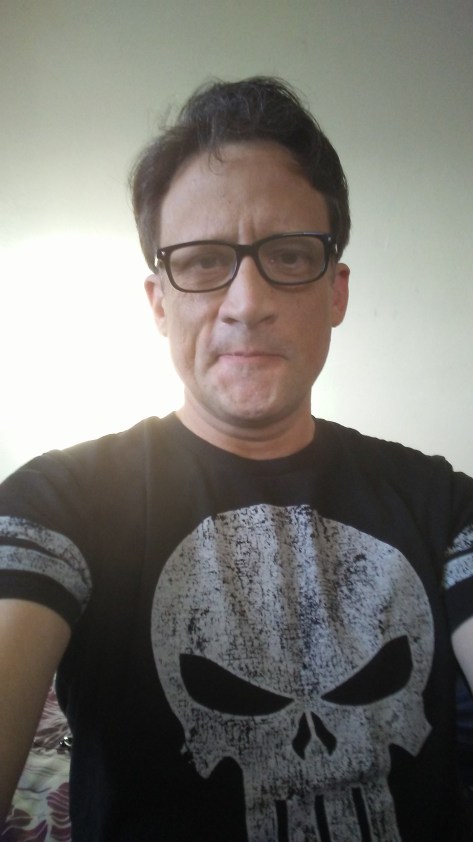
Monday Punisher Selfie because I am nine.

20180205_161152

A review of “The Defenders” (2017)

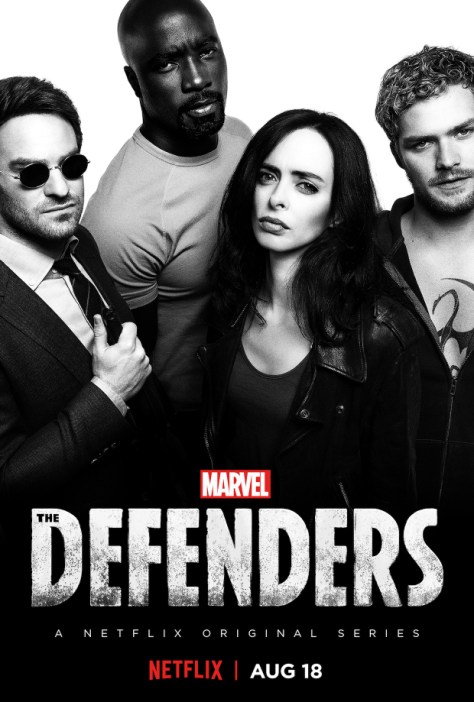
I hate to say this, guys — I really do.  But aside from some admittedly standout action sequences, Netflix’ “The Defenders” (2017) was generally mediocre stuff.  I’d rate it a 5 out of 10 for mostly being a clunky, messily written, rare misfire for the Marvel Cinematic Universe.

What we’ve got here is an eight-episode story arc depicting nothing less than a cabal of mystical ninjas endeavoring to destroy New York City — and four superheros racing to stop them.  And yet it still manages to feel slow.  I’m surprised at how ploddingly so brief and urgent a story concept like that could be executed.

It’s confusing too.  The cabal in question here is The Hand, and their nature, origins, history and modus operandi are all too muddled to follow — the result of sloppy screenwriting.  Their goal within “The Defenders'” storyline is actually pretty narrow and specific by comic book standards — I’m not sure how razing New York is necessary at all.  (Their actions cause … an earthquake?  How, exactly?  And wouldn’t that jeopardize their process if an earthquake occurs earlier than they expected?  Do these mystical ninjas employ seismologists to forewarn them of that?)

Other questions abound as well.  What is “Black Sky,” exactly?  Does it matter much, considering it’s a story element that doesn’t much change things?  Is the resurrected uber-Elektra really that much different from the regular, mortal Elektra we saw in “Daredevil” (2015)?

To make matters worse, the character elements here are frequently off key.  Elektra herself feels like a mostly flat protagonist, the leads sometimes lack chemistry with one another, and the script pays far too much attention to supporting characters that viewers did not tune in to watch.  (If I hear one more saccharine pep talk between Claire Temple and Colleen Wing, I’m going to scream.)

Look, I’m not saying the show was all bad.  Like “Iron Fist” (2017) before it, “The Defenders” partially redeems a bad script with absolutely excellent fight choreography; Hell’s Kitchen is the corner of the MCU with the best martial arts action.  I cheered a couple of times.

I also think that the cast is roundly excellent.  I’ll always love Charlie Cox in the role of Daredevil and Krysten Ritter as Jessica Jones.  Mike Colter is perfectly cast as Luke Cage, and we even have none other than Sigourney Weaver classing up the MCU (even if she occasionally seemed to phone it in a little).

And I’m including Finn Jones as Iron Fist here — I don’t think he’s the show’s “weak link,” as other viewers do.  The actor is actually quite good; it isn’t his fault that his titular series and this follow-up were poorly written.  In fact, I really like the character concept of Iron Fist as it’s presented here.  It’s mired in a lot of weird and dated kung-fu-type cliches, but this is a comic book property, after all.  The character’s shtick might be the closest the MCU comes to having a “Jedi”-type figure, and that’s fun.  (A good friend of mine who is a lifelong Star Wars fanatic really loves “The Defenders,” as well as Iron Fist’s solo show — I don’t think that’s an accident.)  Plus, Iron Fist is a great foil for the other characters on The Defenders team, who are each cynical and traumatized to some extent– he appears young and idealistic and with a sheltered upbringing, like a recent college graduate with superpowers.

I don’t know that I can actually recommend this, as you can tell from the above.  But I will say that nearly everyone I’ve heard from about this show enjoyed it more than I did.  Your mileage may vary.


The-Defenders_EW

A few quick words on the premiere of “The Defenders” (2017)

I certainly wasn’t as thrilled with the premiere of Marvel’s “The Defenders” (2017) as I thought I’d be.  I’d somewhat grudgingly rate it a 7 out of 10.

The show’s first episode suffers a bit from an inescapable challenge — how to satisfy the fanbase for each of four superhero characters who have had their own shows.  I’d honestly say that this show so far interests me about 50 percent of the time — I love Daredevil and Jessica Jones, but I don’t much care about Luke Cage or Iron Fist.  Complicating things further is the show’s need to logically tie together all of their respective storylines, while arousing interest in a new overall story for this nascent ensemble team.  (It … looks a lot like Daredevil’s story from both the second season of the Netflix series and the original comics.)

I’m optimistic I’ll enjoy it more as I catch the rest of the series.  Marvel properties almost always have good writers.  And the large cast here (including none other than Sigourney Weaver) is uniformly excellent.


charlie-cox-mike-colter-krysten-ritter-finn-jones-defenders

A review of “Jeepers Creepers 3” (2017)

Jeepers.

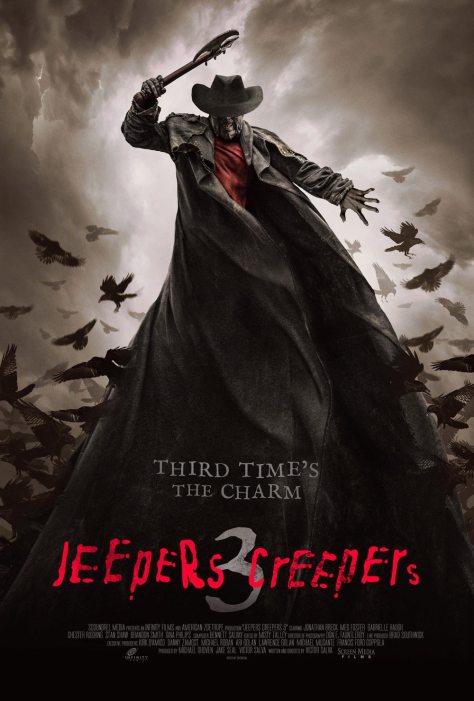
The first two “Jeepers Creepers” movies are vastly underrated classics, in my opinion — they’re well scripted and boast a truly original and frightening bogeyman.  The third, regrettably, struggles to retain even a B movie charm.  It’s a substandard horror film that I’d only grudgingly rate a 4 out of 10.

“Jeepers Creepers 3” (2017) is cloddishly written and awkwardly filmed.  The film also suffers from action sequences that are absolutely cartoonish.  A lot of this stems from the titular Creeper’s antique vehicle, which is now inexplicably depicted as being … conscious?  Possessed by the Creeper?  It drives itself, deflects bullets, launches projectiles, and contains booby traps that defy physics.  This leads to some Wile E. Coyote-style fight scenes with the story’s various protagonists, in which the saddest victim is the franchise’s credibility.

About those protagonists — there are far too many to examine with any real success; the two ostensible teenage main characters fall a bit flat.  There are so many characters that have backstories connected with the Creeper (and his signature, decades-hopping supernatural murder sprees) that the film simply becomes confusing.  And that confusion is made worse by this film’s chronology with the previous movies — it takes place immediately after the first, but before the events of the second.  (In all fairness, maybe the problem is me … I am being quite honest when I write here that I just do not follow movies as well as other people.)

With all of this exposition, though, one bit of lore is egregiously omitted – contrary to some of the movie’s advance press, we learn nothing about the creature’s origins.  And this is extremely odd, because a bunch of characters do.  There is a befuddling central plot point where the good guys methodically gain knowledge of their otherworldly foe by … touching one of its severed body parts.  But we, the viewers, learn nothing.

Even the makeup and special effects were inferior to the prior films.

I’m confused by all of the things I’ve written above, as “Jeepers Creepers 3” was written and directed by Victor Salva, who wrote and directed the excellent previous movies in 2001 and 2003.

I hope I’m not being too hard on the movie, because there’s still some fun to be had.  Jonathan Breck still chews the scenery quite nicely as the Creeper, and the monster’s character concept still manages to please.  In a horror movie market often dominated by seemingly interchangeable serial killers and undead little girls, the Creeper is a truly inventive monster — part human; part gargoyle; part body-stealing, feral Frankenstein’s monster.  He’s fun to watch, particularly for horror fans who’ve grown tired of the Patrick Batemans and the various angry ghost children that endlessly haunt the zeitgeist.  You could do a lot worse for a plot-driving antagonist.

And, thanks to so brutal a bad guy, there are occasional moments of tension in the movie.  It’s a bit scary, for example, when he attacks a group of teenaged motorcyclists.

This isn’t enough to make recommend paying for the movie, however — even if you’re a fan of the franchise, as I am.  I’d wait for “Jeepers Creepers 3” to hit Netflix or Hulu, or wait until it’s playing on SyFy again.


'Jeepers_Creepers_3'_theatrical_release_poster

A short review of “Death Note” (2017)

True to its manga origins, Netflix’ “Death Note” (2017) seems cartoonish and sometimes intentionally silly.  That doesn’t stop it from being a lot of fun, though — this is the most original, offbeat horror tale I’ve seen in a while, and I’d rate it an 8 out of 10.

It’s definitely a genre-buster — it’s one part comic book, one part horror tale, one part eastern theological fantasy and one part dark teen romance.  It succeeds in part because it has an interesting supernatural story setup that seems reminiscent an episode of “The X-Files.”  (A magical notebook allows it owner to sentence anyone to death, simply by writing the victim’s name down, and describing how they die.)

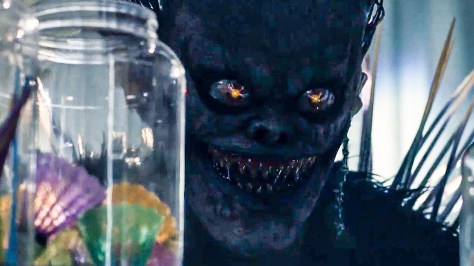
It also succeeds because it has a great bogeyman — a seemingly omnipotent demon named Ryuk.  His visual design is creative and wickedly creepy, and his character is menacingly voiced by none other than Willem Dafoe.

Finally, Shea Whigham is very good as the teen protagonist’s tough but likable dad.  I thought I remembered him only from his relatively minor role in this year’s “Kong Skull Island.”  But, as it turns out, he was actually the sympathetic escaped convict from 2008’s criminally underrated monster movie, “Splinter.”  He’s a great actor.

I really liked this.  I’d recommend it.


Death-Note-Light-Poster

maxresdefault