Tag Archives: 2002

Episode 1 of “Black Summer” (2019) looks quite promising.

The hectic first episode of “Black Summer,” Netflix’ new zombie series, looks like ambitious stuff — it plays like a hybrid of “28 Days Later” (2002), “Pulp Fiction” (1994) and “24” (2001-2014).  While it seems unlikely that this show can emulate the greatness of those classics, “Black Summer” still gets off to a damned good start.  I’d rate the first episode an 8 out of 10 for being a pretty lean and mean start to a decent zombie series.

Part of the episode’s appeal is its frantic vibe and format — something that seems like a deliberate contrast to “The Walking Dead’s” slowly placed, methodical epic.  The viewer is plopped down into the middle of a heartland neighborhood evacuation effort, three weeks into a zombie epidemic.  With a series of lengthy, real-time tracking shots, we race beside a collection of unconnected characters who are desperately trying to reach United States Army pickup point.

The zombies are few in number.  But they are the “high-speed zombies” that most modern horror viewers associate with Danny Boyle’s film, so the arrival of even one imperils the fleeing families.  The makeup effects are good, the transformation process is effectively rendered, and the show is satisfyingly scary.  The show makes this even more interesting by filming each character’s dash individually, and then showing them as discrete vignettes that are out of chronological order.  

The story is weakest when it slows down enough to allow its characters to talk.  The dialogue is truly bad, even if the quick action sequences make up for it.  (Has there ever been a more generic bribery offer, for example, then the one we see here?)  But this weakness doesn’t much affect the overall quality of an episode that follows so much action.

I was even more surprised that the episode works when I googled “Black Summer.”  The Netflix series is produced The Asylum, the film company notorious for “mockbusters” like “Dead Men Walking” (2005), “Snakes on a Train” (2006) and … sigh … “Transmorphers” (2007).  What’s more, “Black Summer” is intended as a prequel series to  The Asylum’s “Z Nation,” the lamentable horror-comedy zombie series that ran for three seasons on SyFy.  (It was so bad I couldn’t get through a single episode.)

It’s a weird world.


black-summer

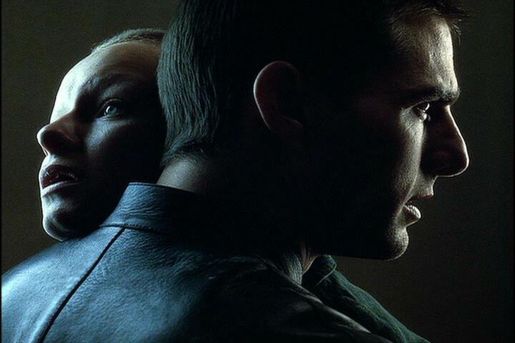
Alpha on “The Walking Dead” was Agatha in “Minority Report” (2002).

Didn’t see that one coming.  (Waitaminute. Why are actors “on” shows, but “in” movies?)  The name of the actress is Samantha Morton.

She’s bald in both roles, and both roles depict her in dystopias.

And her characters are repeatedly referred to by others as “the strongest” member of their group.

AND both the show and the film place her in a key plot arc in which girls are taken from their mothers.  Damn.


agatha-john.0


A short review of Episode 1 of “The Passage” (2019)

I’m all for a good vampire story.  But this isn’t a particularly good vampire story.

Or, at least not yet, it isn’t.  Don’t get me wrong — the premiere of “The Passage” wasn’t the worst hour of television I’ve ever seen.  I’d rate it a 5 out of 10 for being somewhat average.  It has two good leads in Mark-Paul Gosselaar and Saniyya Sidney.  Gosselaar is no Laurence Olivier, but he’s good enough, and he looks and fits the part.  He seems like an excellent physical actor in the premiere’s brief action sequences, which weren’t altogether bad.  Sidney is downright terrific — and she’s an adorable kid too.

The show also has a great plot setup going for it, which I won’t spoil here.  It’s based on a trilogy of dystopian horror novels by Justin Cronin, which actually sound like some quite interesting books.  There are even a couple of sly references to well known horror films like “Bram Stoker’s Dracula” (1992) and “28 Days Later” (2002).

Regrettably, however, “The Passage” suffers a lot from rushed and clumsy storytelling.  The script is a poor one, with a lot of awkward exposition and forced emotion.  (It shares a weakness with this year’s vastly superior “Bird Box,” in that it tries to fit too much of its source material into too little screen time.)  It falls well short of being scary, too, which is probably what will alienate modern horror fans, unless it improves.  (This is a primetime network TV show, and isn’t any more frightening than the average episode of “Star Trek.”)

Weird world — Gosselar is none other than the Zack from “Saved By the Bell” (1989-1993).  And am I the only one that thinks he is the spitting image of Chris Pratt in a lot of shots.  I almost thought it was Pratt from the ads.


mv5bnjcymja2mjuwmf5bml5banbnxkftztgwmda3oty3njm@._v1_sy1000_cr0,0,675,1000_al_

A short review of “Patient Zero” (2018)

I’d be lying to you if I told you that “Patient Zero” (2018) is an especially good movie.  It isn’t.  It plays a lot like the classic “28 Days Later” (2002) would play if it were produced by the SyFy Channel, and by that I mean it generally is a poorly written, low-budget cheese-fest.  (This is one of those movies where even the score was kinda bad.)  Still, there were some hints of greatness hidden within this lackluster zombie movie — enough to save it from being a complete failure — and I would reluctantly rate it a 5 out of 10.  (Most other reviewers are not even that kind.)

First, it has some fine performers. These include two “Game of Thrones” actors who are always fun to watch — the mesmerizing Natalie Dormer and the consistently likable John Bradley.  (The latter seems to specialize in winning audiences over as the “hero’s-affable-friend” role.)  “Doctor Who” fans will of course recognize Matt Smith in the lead role.  But by far and away, they’re overshadowed by a fantastic performance by Stanley Tucci as the zombies’ surprisingly eloquent leader.  (More on that in a moment.)  Tucci is truly a great actor and he makes a perfectly menacing bad guy; his voice, diction and line delivery are goddam perfect.  His talent for voicing a magnetic, highly intelligent antagonist reminds me of Jeffrey Dean Morgan’s portrayal of Negan on “The Walking Dead,” or one of the better “big bads” seen on “24” (2001 – 2014).

Second, there are some really clever ideas hiding under this thin, hasty script.  (I strongly get the sense that “Patient Zero” was a rush job for screenwriter Mike Le and director Vincent Newman.)  The hyper-kinetic zombies here are afflicted with “super-rabies” and are reminiscent of their ilk from “28 Days Later.”  But there is a truly intriguing plot conceit — their roars and screams are perfectly intelligible to Smith’s protagonist.  He speaks their “language” because he’s infected, but also mysteriously asymptomatic.  When he interrogates the zombies for the military, their interaction is filmed as normal dialogue (creating the opportunity for Tucci’s terrific turn here).  Then things get even more interesting when it’s demonstrated that the ostensibly mindless zombies are quite proficient at planning an attack.

I … might be treating this movie a bit charitably simply because I liked some of its ingredients.  Again, I don’t actually recommend it.  But your mileage may vary.


17YBhcjXvv5BFz433OcF1UqcGzd

“Girl with Heart Balloon,” Banksy, 2002

London.

BANKSY_LONDON

Photo credit: By LYDIA and her SALAD DAYS (Flickr: BANKSY : LONDON) [CC BY-SA 2.0 (https://creativecommons.org/licenses/by-sa/2.0)%5D, via Wikimedia Commons

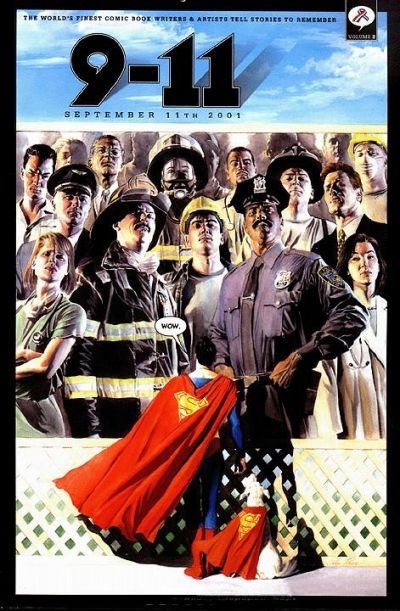
Cover to “9-11: The World’s Finest Comic Book Writers and Artists Tell Stories to Remember,” Alex Ross, 2002

DC Comics.

9-11_2

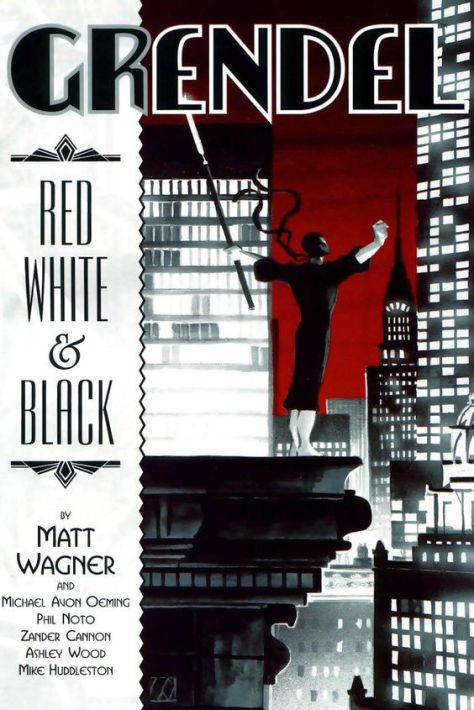
Cover to “Grendel: Red, White & Black” #3, Matt Wagner, 2002

Dark Horse Comics.

06492f54f6b1b8cb6d84bfdabb065fc2

A review of “The X-Files” Season 10

I breaks my heart to say this, but 2016’s long-awaited return of “The X-Files” was not a triumphant one.  (Indeed, I am writing this review nearly two years after its conclusion because I only recently got around to watching the last of its six episodes.)  I’d rate the brief season a 4 out of 10 — the lowest rating I’ve ever given to a season of the show.

I hope this year’s Season 11 proves me wrong, but I’m finally starting to wonder of “The X-Files'” time has come and gone.  (This is coming from someone who was a lifetime fan.  I even thoroughly enjoyed seasons 7 through 9, which was when much of the show’s loyal fan-base began truly eroding between 1999 and 2002.)

So many of the show’s core elements seem outdated now.  The character arcs of its two heroes and their relationship were resolved seasons ago.  Its central overriding story arc — an elite cabal’s conspiracy about (and with) aliens — appears to have been milked for most or all all of its entertainment value.  And the show’s format of mixing a handful of “conspiracy episodes” with standalone “monster-of-the-week” episodes feels awkward compared with contemporary programs that better integrate multiple plot lines.  (Consider HBO’s “Game of Thrones,” for example, or even the various Netflix and television series that are part of the Marvel Cinematic Universe.)

The truly fatal blow to “The X Files'” staying power, though, runs a bit deeper — network television just isn’t as positioned as it used to be to tell the scariest stories to a wide audience.  There is too much competition from sources less beholden to censorship or to the milquetoast sensibilities of mainstream appeal.  The first is easily accessible cable channels like HBO and AMC, which can shock viewers with visceral violence.  The second is subscription services like Netflix.

And third is simply the Internet at large, with its endless cornucopia of morbid or bizarre content.  “The X-Files” was created before the Internet was a common household utility.  Part of the show’s appeal was that it offered people the creepiest stories they’d watch anywhere anywhere outside of a movie theater.  And those stories at least seemed well researched by the program’s writers, who did a tremendous job for most of the show’s run.

Today’s Internet-connected entertainment marketplace is different.  No matter how much weirdness “The X Files” can pack into a 43-minute episode, the average consumer can find material online that is darker or more frightening in less time than that.  Compare the average “X-Files” episode, for example, to the array of material devoted to real-life “paranormal” subjects, like “Slender Man,” alleged UFO footage, or tragedies like the mysterious death of Elisa Lam.  (That last one is truly shudder-inducing.  Google it at your own peril.)

The only way a show like “The X-Files” can hope to compete is with excellent attention to tone, tension and character — something I thought that seasons 7 through 9 did pretty well with, despite a gradual fan exodus after David Duchovny’s awkward departure from the series.  Season 10 just didn’t follow suit.  It really was as though a range of previous “X-Files” episodes has been thrown in a blender, so that their component parts could be served yet again.  The conspiracy stuff, in particular, was poorly executed, too hastily paced, and just a bit too campy for my taste.  Mulder and Scully’s return was also too self-conscious — as though Duchovny and Gillian Anderson were reunited for a tongue-in-cheek reunion special.

It wasn’t all bad.  These two leads are always fun to watch.  The fourth episode was superb — “Home Again” served up both a creepy, macabre story and a meaningful character arc for Dana Scully.

Episode 3, “Mulder and Scully Meet the Were-Monster,” was also fun enough.  But while a lot of other fans absolutely loved this humorous entry, I personally didn’t feel its central joke merited a full episode.  Besides, this particular twist has been done before, in a 1989 book by a well known speculative fiction author.  (I won’t name the book or the author here, in order to avoid spoilers.)

The rest of the episodes were … fair, I suppose.  Oh, well.

I’m thrilled that we’re currently being given Season 11 of “The X-Files.”  As someone who was a longtime fan, I never envisioned the show lasting this long, even after a hiatus of many years.  I just hope the show matures and grows in quality after this disappointing rebirth.


XFilesStillOutThere

A review of the pilot for Stephen King’s “Mr. Mercedes” (2017)

With all of the (frequently quite poor) buzz about the arrival this summer of “The Dark Tower” and “The Mist,” “Mr. Mercedes” might be the Stephen King adaptation that has slipped under the radar.  And that’s a shame, because the pilot episode suggests it might be one of the best King adaptations ever.  I’d rate it a 9 out of 10.

It really is that good.  The show’s first episode begins what looks to be an intelligent horror-thriller that is surprisingly faithful to King’s outstanding novel.  David E. Kelley’s script is excellent.  After a brutal prologues that sets its plot in motion, the story proceeds with three-dimensional, likable characters who are well played by their performers — especially Brendan Gleeson in the role of the grumpy, retired-cop anti-hero who is harassed by a mass murderer.  (Yes, that is indeed the Dad from 2002’s “28 Days Later.”)  Gleeson is just great — even though I found myself wondering why a retired Chicago cop should have a heavy U.K. accent.

The script even surprises us by being incongruously sweet during its odder moments.  Like its source material, the show effortlessly sets up characters that are easy to like.  (An exchange between Gleeson some kids playing hockey outside his house, for example, was truly inspired.)

The story’s plot-driving horror elements are disturbing, too — both in terms of its grisly violence and its sexual taboos.  This is not a show for the faint of heart.

This also seems like it could be a King adaptation that could easily appeal to people outside his usual fanbase.  There are no supernatural elements to this story, or any tangible connections to King’s sprawling, interconnected “Dark Tower” multi-verse.  (The original novel seemed to show us King trying his hand at a Thomas Harris-type serial killer tale.)

The only reservation I might have about “Mr. Mercedes” is what I am guessing about its pace.  The original novel was quite slow, despite being an engaging read.  After its gut-wrenching mass murder is depicted in graphic detail, the plot moves forward rather lethargically.  The one-hour pilot episode here seemed to mirror that, in its apparent loyalty to its source material.  I predict that viewers turning to “Mr. Mercedes” for a fast-paced horror tale will be disappointed.

I think that’s probably a subjective quibble on my part, though.  I’d still enthusiastically recommend this.


A very short review of “The Dead” (2010)

Take a look at the movie poster below for the Ford Brothers’ “The Dead” (2010).  It’s problematic for two reasons.

One, of course, is that it contains what is arguably the most unimaginative title in zombie movie history.

Two is its immediate recollection of the marketing art for Zack Snyder’s terrific 2004 “Dawn of the Dead” remake.  It is so similar in composition and color scheme that it makes the Ford Brothers’ film look like a “mockbuster,” whose cover is designed to fool hasty movie renters.

And that’s a shame, because “The Dead” is a fairly decent zombie movie in its own right — I’d rate it a 7 out of 10.  It’s a lower-budget feature, and some of the acting is a bit flat, but this is a movie that does a lot with a little.  The film wisely makes the most of its African setting, and has an intelligent, if slowly paced, story.  It focuses on its two military protagonists’ needs for food, sleep, shelter, fuel and vigilance, during the course of a lengthy overland trek.  That’s refreshing in an era of “Strippers vs. Zombies” (2012), and various fairly lackluster clones of “Shaun of the Dead” (2004).

Best of all, however, is the film’s skilled manner of evoking “slow burn” or “creeping” horror.  The zombies in “The Dead” usually move quite slowly.  They might be the slowest zombies I’ve ever seen.  This might be the anti-“28 Days Later” (2002).  But that makes the vibe here unique among the spate of modern zombie films — and maybe a little reminiscent of George A Romero’s pioneering early films.  If your reaction is like mine, you’ll find it a little unnerving to see them gather en masse at a snail’s pace.

I recommend this.

the-dead-1464333825197