2016 has been good to me so far; I’ve been lucky to have a few pieces published since the start of the year. If you like my poetry and care to peruse my publications since January 1st, then just click the link below:
Tag Archives: Eric Robert Nolan
A very quick review of “Time Lapse” (2014)
Despite it being highly recommended, I almost stopped watching “Time Lapse” (2014) after a few minutes. But I’m glad I stayed with it — it’s a smart, damn fun and unexpectedly dark time-machine tale that transcends its microbudget to become edgy and entertaining. I’d give it an 8 out of 10.
It begins weakly. A few strictly average actors perform what seems like a weak script right out of a sitcom doomed to cancellation. Its premise seems cheesy — three friends discover a mysterious camera that can take pictures of its subject as it will be 24 hours into the future. Its plot sounds trite and unwieldy. (They send themselves photographed notes containing advice from their future selves.) Even the film’s minimalist set (the movie appears to have only two of them) seems to betray the threadbare budget of an earnest-but-average film school project.
But, damn, was I pleasantly proven wrong. The script turns out to be quite strong, inviting the viewer down a progressively frightening and maddening rabbit hole alongside its characters. The acting improves, as George Finn settles into his role as the greedy, impulsive and least stable of the trio. (Trust me, this isn’t just a cliche sci-fi morality tale about greed; the movie has far more to offer than that.) Then Jason Spisak arrives and masterfully almost steals the entire movie, chewing the scenery as a fabulously frightening bad guy.
The last shot of this movie is absolutely killer.
Seriously, check this film out. It deserves its positive press, and I guarantee it’ll at least surprise you with how good it becomes.

A very short review of “Coherence” (2013)
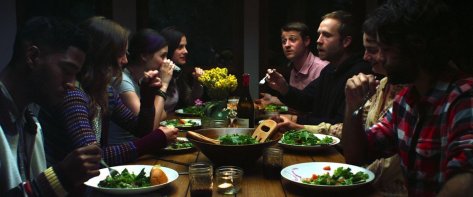
James Ward Byrkit wrote the screenplay for “Coherence” (2013), then filmed and directed it on a shoestring budget in his living room. And the result is pretty impressive — this a trippy, unusual, and unusually cerebral science fiction thriller. I’d rate it an 8 out of 10.
The movie portrays eight friends at a dinner party who find their sense of reality frighteningly altered after a comet flies overhead. I really can’t write much more than that without spoilers — even this movie’s central story device is best arrived at as a surprise for the viewer. I don’t even want to name which “science” serves as the basis for the “science fiction” here, as that would be a big hint as to what transpires.
It’s pretty good. The thriller elements here are creepy. And it’s a wonderfully intelligent “what-if?” story that other reviewers have compared to “The Twilight Zone” episodes. (I myself … mostly kept up with it — I was sometimes a little murky about the strategies adopted by the group to address their predicament.)
The closing minutes are damned good.
I’d recommend this to sci-fi fans looking for a unique, dialogue-driven brain-buster.
Hey, just for fun, consider this — the refreshingly intelligent “Coherence” employs the exact same MacGuffin as one of the stupidest, overrated cult “classics” of all time — 1984’s “Night of the Comet.”

“The Revenant” (2015) was astonishingly good.
“The Revenant” (2015) changed the way that I see movies. This utterly immersive, jaw-droppingly gorgeous period thriller is easily one of the best films I’ve ever seen, and I plan to see it again, soon. I’d rate it a perfect 10.
It’s a visual masterpiece. Its cinematography renders its mountains, valleys and plains both dreamlike and lucid, and its action is unflinchingly visceral. Shot mostly in Alberta, Canada (standing in for 1823 Montana and South Dakota), the film’s visuals are more stunning than anything I’ve ever seen. You truly do feel that “you are there.” But “there” is an absolutely brutal 19th century middle American winter wilderness. It’s fatally dangerous, both with its unforgiving elements and with the human violence that seems to erupt casually and constantly over its land and resources — not to mention bloody retribution among groups and individuals. This isn’t a movie for the faint of heart. I won’t spoil the subject of its gut-wrenching action sequences for fear of spoilers — most of these sequences arrive as frightening surprises, thanks to Alejandro G. Inarritu’s expert direction. It is this juxtaposition of beauty and brutality that define the movie.
Leonardo DiCaprio plays Hugh Glass, an American trapper who begins as one of the seemingly few characters that do not quickly resort to unnecessary violence, prejudice or revenge. He later does seek vengeance for his son’s death against fellow trapper John Fitzgerald, played by Tom Hardy. (Glass was a real frontiersman who was the subject of Michael Punke’s 2002 biography, “The Revenant.” But a cursory Google search suggests to me that this is not actually “a true story;” I think of it as loosely based historical fiction.) Like DiCaprio and Hardy, Domhnall Gleeson and Will Poulter also excel in their supporting roles. (Gleeson seems to specialize in playing reluctant innocents; I remember him from his skilled performance as the gentle young computer genius in last year’s outstanding science fiction thriller, “Ex Machina.”)
But the main star of “The Revenant” is the setting itself, beautifully shot by Emmanuel Lebezki and masterfully employed by Inarritu as a kind of character unto itself in the story. It’s lovely. I’ve never seen a movie like this. And while I’m no film connoisseur, or even a genuine critic, I’ve seen a lot of good ones.

The direction most reminds me of Francis Ford Coppola’s work in 1979’s “Apocalypse Now.” I was also reminded of Stanley Kubrick’s “The Shining” (1980) — that was a film that also depicted threatening snowscapes as dreamlike and eerily beautiful. There was one shot near the end, following DiCaprio’s vengeful hero on his path through immense firs on either side — it reminded me a lot of Jack Nicholson’s murderous Jack Torrance on his path through the hellish hedge labyrinth.
There is also a central action set piece involving an attack on one group of characters on another — it actually reminded me of Oliver Stone’s work in “Platoon” (1986). Like Stone’s finale, the battle is staged so that the viewers have no sense of which direction the attack is coming from, paralleling the experience of the confused defenders. There are countless long tracking shots throughout this film, with fewer cuts — and amazing circular surrounding shots of the action. I’ve read that Inarritu actually had to transport cranes to his mountaintop shooting locations in order to execute those.
If you had to find a flaw with “The Revenant,” I suppose you could complain that its story and characters are thin. We know little more about DiCaprio’s Glass beyond that he is competent, patient and slow to fight — then merciless and unrelenting in seeking justice. Poulter’s Jim Bridger is loyal, but not as strong as the hero. Hardy’s Fitzgerald is a greedy, opportunistic bully whose murder of an innocent drives the plot. That’s … little more than the plot and characters of a lot of throwaway westerns, isn’t it? (I’ve indeed seen this movie categorized as a western in reviews. That’s technically correct, I guess, but it feels too unique to pigeonhole that way.)
You could easily read the movie for moral ambiguity. There are the obvious issues connected with revenge, of course, underscored by a final shot in which one character appears to break the fourth wall. I found myself wondering about Glass’ compatriots. Yes, it is Fitzgerald who acts villainously, but all of Glass’ fellow trappers also consign him to death by abandoning him after his injuries. I do understand that they feel they can’t survive themselves if they try to carry him back to their staging area at Fort Kiowa. But … is what they do “right?” What would you or I do?
I think I am coming too close here to revealing too much about the film. The best way to experience “The Revenant” is to walk into it knowing little about it. I strongly recommend you do so.


Cool, but should I worry about where the rest of it is?
Found: one dragon claw. Talons and all.

My review of “The Walking Dead” Season 6
Season 6 of “The Walking Dead” ended terribly last Sunday night, with a gimmicky, redundant, cartoonishly filmed cliffhanger that seemed like a power trip for the show’s writers and a shameless trick to ensure ratings for the Season 7 premiere. Even that blunder, however, can only partially mar an otherwise great season of television; I’d still give the sixth season a 9 out of 10.
Seriously, Sunday night’s closing minutes were a big disappointment. We did not — I repeat, we did NOT — get to see which of our heroes would fall victim to new arch-villain Negan and his barbed-wire baseball bat, “Lucille.” (I don’t think that I’m writing a spoiler here, as I’m informing the reader of an event that was not yet depicted.) We get to see the dramatic and frightening events leading up our heroes’ capture — overall, the episode was pretty good, I think. And we get to see some iconic images and hear dialogue that we remember from the original comic series. And we finally get to see Jeffrey Dean Morgan appear as the new big-bad, something the show’s marketing suggests AMC believed fans would be happy with alone.
But the season ended with a cheesy point-of-view shot of the nameless individual who Negan executes, then a black screen along with the muffled screaming and shouting of those protagonists who are left to witness their friend’s murder. (Check Youtube — some pretty ardent fans have actually analyzed the sounds and provided subtitles, supposedly providing clues as to who the victim was.) And the manner in which it was filmed was kitsch — it reminded me of the over-the-top POV shots employed by Sam Raimi.
I think this is poor storytelling. The Saviors storyline has been building for at least half a season (earlier if you consider the first encounter with Dwight), and the death of one of our heroes was the universally expected, logical conclusion of that. The cliffhanger also felt like a little bit of a “f*&% you” to the fans. The show’s creators know that its viewership was so eagerly anticipating an answer to the million-dollar question — “who dies?” And they showed us that not only have they enjoyed stringing us along, they’re going to enjoy gratuitously stringing us along for another seven months until Season Seven.
And, hey, it looks as though this parsimonious storytelling will be the case with tie-in promotions as well. I read today over at Hollywood Reporter that Robert Kirkman has produced a 48-page comic containing Negan’s backstory. As you may read at the link below, however, only four pages at a time will be made available to fans, as they are released monthly in a comics preview catalog, “Image +.” (And I’m unclear about whether readers will have to pay for that.) C’mon. Gimme a break:
http://www.hollywoodreporter.com/live-feed/walking-dead-see-first-page-881581
Furthermore, the final scene was a little problematic in other ways. I liked Morgan’s performance, but I he didn’t knock my socks off as he apparently did for other fans. The monologue scripted for him was far too long. Much of it is lifted from the comics; I think that a lot of it did not translate well from page to screen.
Finally, the cliffhanger was redundant — didn’t the season’s penultimate episode also tease a major character death in its final seconds, employing a cheap visual trick to obscure this person’s fate?
Ah, well. Like I said, I think Season 6 actually was stellar. We hardcore fans tend to criticize our show a lot (hence my bitching above). Our criticisms are often well deserved, but I think we might have been spoiled a bit by “The Walking Dead.” After six years, five of which were downright addictive, it’s easy to lose sight of how groundbreaking the show has been.
There has never been anything else like it on television. The fact that it’s the first real zombie apocalypse serialized horror show is obvious, along with its new levels of gore, pathos and goddam amazing makeup effects. But think also about its breadth and scope — since Season One, I think it’s gone to great lengths to tell an epic story. Budget constraints — including a limited range of shooting locations in rural southern Georgia — restrict it somewhat. But like no other show before it, it portrays a horrifying apocalypse from the points of view of a very broad and constantly changing ensemble of characters.
Sometimes this broad and changing ensemble works against the show. I think one of its weaknesses is that it sometimes doesn’t feel like a well crafted, deliberate story at all, but rather a kind of “reality show” like “Survivor” (2000 – 2016). Instead of watching in suspense to see who is “voted off the island,” we instead watch in suspense to see whether our favorite fictional character meets a grisly end. I wouldn’t be surprised if people placed bets. (I’ve heard that people indeed used to bet on “Survivor” in Las Vegas.) Consequently, it feels more like bread-and-circuses than real meaningful storytelling within a post-apocalyptic context.
But “The Walking Dead” still manages to be damned good. Early on in Season 6, I commented to another fan that the show actually seems to be getting better. It’s getting smarter, with more ideas, and greater attention to detail. I honestly get the sense that its writers sit down and think about the plausibility and logistics of various elements of this imaginary world.
It has essentially become a war story, even when it’s often just a neverending war of attrition with a universal enemy. The writers grasp this, and they pick up the ball and run with it. Attention is paid to strategy, logistics, leadership, morale, levels of training and commitment — Rick’s grand plan to lead the newly released “herd” away from Alexandria in the season’s earliest episodes is a great example of this.

And there is far more world-building. Based on my familiarity with the comic book series, I recently advised another fan that the entire structure of the show would change. Instead of people moving place to place and negotiating the various threats there, we now see stationary groups of survivors either fighting or cooperating with one another’s societies — something we’ve previously only really seen with The Prison vs. Woodbury. This creates a range of larger, more layered and interesting storytelling possibilities. And there are more enclaves even than we’ve seen so far. (I’m trying to keep this spoiler free.)

Complementing this new change in story structure are elements of the show that seem to have improved even further. The action and suspense have increased greatly. I found myself on the edge of my seat during a few episodes — the one that comes to mind is when our heroes invade the satellite station.
The horror elements are new and stronger. Story arcs involving the Wolves were extremely unsettling. (I myself wanted far more of that bizarre little clutch of psychopaths. Are they a cult? Do they have a coherent ideology?) The Saviors, whose survival skills and competence match or exceed Rick’s group, are frightening, especially for those of us who are already acquainted with them through the comics.
I even find I like the show’s drama better in this and recent seasons — more so than in the show’s early years. Yes, the sad, unsupported, inexplicable recent character change in Carol was a disastrous choice. And Abraham’s love triangle was a mostly inscrutable nod to the comics. But there were a lot of other good things to be found this season — Morgan’s backstory, Nicholas’ character arc, the arrival of Jesus and the outcome with Denise.
All told, it was a great season. Maybe someday a DVD special edition can rectify its final minutes, and supply a necessary face for Negan’s anonymous victim. Hey, the show obviously wants to milk each cow for all it’s worth, right?

Throwback Thursday: T.S.S. in Middle Island, NY
This “Throwback Thursday” post is one to which only my longtime fellow Long Islanders might relate. And it’s really more of a bittersweet news item … I signed onto Facebook the night before last only to see this message from a great old friend from the neighborhood:
“They tore down the old T.S.S. today.”
Yes — that’s “T.S.S.,” as in Times Squares Stores, even though nobody ever called it the latter. And “T.S.S.” is an appellation that only the 40-and-up-ish crowd would recognize, I think. Everyone else thinks of it as “the old K-Mart.” But in the late 70’s and early 80’s, it was a sprawling local family discount store.
I and other Longwood High School kids have a hell of a lot of memories from there. I remember accompanying my parents there during their shopping expeditions when I was .. maybe the age from Kindergarten through the third grade?
“Warehouse”-type club stores weren’t really a thing back then. T.S.S.’ immense space was truly impressive to a little boy; it seemed like a world unto itself. We all remember the toy section — that was where I browsed wistfully through the very first Star Wars figures — I’m talking the original toys released in connection with the 1978 and 1980 films. I still remember them arrayed along the racks in their original packaging — Lord only knows how much those racks of unopened original toys would be worth today. I’m also pretty sure that’s where my parents picked up those Micronauts figures I got for Christmas one year. Come to think of it … I’ll bet the majority of my Christmas presents were bought there.
I also vividly remember the bedding department, for some reason. I think it’s because I really took a liking to some Charlie Brown bedsheets I saw displayed there.
But more than anything else, I remember the weird entranceway — they sold concession-style drinks and snacks on both sides, the better to appeal to children to beseech their parents.
There’s a neat little blog entry, complete with the store’s original TV commercials, right here at LongIsland70skid.com:
http://www.longisland70skid.com/tss/
T.S.S. was such a vivid, memorable part of my early childhood that it was pretty damned depressing for me Tuesday to discover its eventual fate. I’m not talking about the sprawling space being razed. I’m talking about the goddam dystopian state of disrepair into which the entire commercial property fell.
After some long intervening years during which the space became a K-Mart, the building just went to hell after that doomed chain went as defunct as T.S.S. Tuesday’s Newsday article, below, should give you the rundown.
And the rundown isn’t pretty. Over the past decade, it seems that the “hulking eyesore” of a building was the site of squatters, drug users, and encroaching wild plantlife. If you have fond childhood memories of the store, then do not perform a Google image search for the location, as I did. It’ll show you a massive, vacant monolith of a building on a vast, overgrown, dangerous looking lot. It looks frikkin’ postapocalyptic. And it’ll make you sad.
And if that weren’t enough, a murder victim was found this past Saturday in the woods just next to the site:
“Middle Island vacant K-Mart demolished days after body found,” by Carl MacGowan, Newsday, 4/5/16
They say you can never go home again, huh?
A very short review of “10 Cloverfield Lane” (2016)
“10 Cloverfield Lane” (2016) is a capably written and well performed thriller; it might not be quite worth the high praise it seems to be receiving elsewhere, but I’d still give it an 8 out of 10.
Mary Elizabeth Winstead actually is terrific actress. She has far more to do here than her one-note heroine in 2011’s underrated “The Thing” prequel, and she performs beautifully. John Goodman is perfect as a mentally ill, dubious savior. John Gallagher, Jr. does just fine as a good-natured everyman in over his head.
I did think that “10 Cloverfield Lane” ran a little long for its content. This could have easily been an especially well executed episode of a one-hour show like “The Outer Limits” or “The Twilight Zone.” It’s feature-length format felt a little padded. We don’t need the prologue explaining why Winstead’s character is traveling. Nor do we need the movie’s slowly building character arc for Goodman’s “Howard.” (We know to suspect his stability from the trailer.)
This appears to have very little to do with “Cloverfield” (2008).

An annual April 2nd disclaimer
No, guys, I have not been hired by any United States Antarctic Research Program to assist John Blair and his fellow scientists at Outpost 31. Neither will I be relocating to any research base in Antarctica. Nor do I have a college alumnus named R.J. MacReady.
Those were lies. My post yesterday was an April Fool’s Day prank. The setting and people I described yesterday are derived from the classic 1982 sci-fi/horror film, John Carpenter’s “The Thing.”

I am going to Antarctica!!!
I am absolutely thrilled to report here that I will be spending a year in Antarctica, having just finalized a contract as a grant-supported scientific writer for the United States Geological Survey.
This is a truly enviable position for which I am very grateful — especially to Eugene Landings and his fellow board members of the USGS Mid-Atlantic Division in Washington, DC. The final candidates for this federally supported position were indeed a competitive group, and I am honored that the board selected me to fill this important short-term consulting position. Thanks too to Mr. John Blair, Senior Biologist at Outpost 31 of the United States Antarctic Research Program, for the time he took to interview me via telephone.
I am also quite grateful to R.J. MacReady, my Mary Washington College Alumnus, for alerting me to this position and motivating me to apply. I wouldn’t have sat down to fill out that lengthy application if it hadn’t been for R.J. assuring me that I had the chance. Thanks for the confidence you instilled in me, “Flyboy!”
Those who are fluent in the natural sciences know that the USGS, despite its low profile, fulfills a critically important national mission — studying new frontiers, their landscapes, their natural resources, and any threats to those resources. As part of the USARP, I will employ my technical writing experience to document some our nation’s leading scientists in exploring Antarctica and its geological infrastructure. I might also be working with their European colleagues, as Norway operates a separate research facility 50 miles away.
I will be staying at “Cosmos House” at Outpost 31; Mr. Blair sent me the pictures you see below.
Here’s The Thing — you might not be hearing much from me for … maybe another 13 months! I will need to leave for Antarctica on May 6th, and I’ll need to bundle up and make all sorts of personal preparations before I depart. Then it’ll be a full year with a very busy schedule and somewhat limited Internet access. Communications specialist Robert Windows has explained to me that all communications are routed via satellite, and they are occasionally hampered by weather.
I’ll update you all further as additional details develop! In the meantime, please wish me luck!